


Federal Biomass Targets Take Center Stage in Webinar
As we prepare for the 2026 Biomass Webinar Series to kick off in July (register here), please enjoy this first in a series of posts highlighting presentations from the 2025 Biomass Webinar Series. This one is from Matt Langholtz, the lead author of the 2023 Billion Ton Report, which is the authoritative assessment of how much biomass is available to use for biofuels without affecting current food and wood use.
Urbana, Illinois — In January 2025 we kicked off the Biomass Webinar Series, bringing together researchers, industry leaders, policymakers, and growers across the Midwest and beyond to foster collaboration and share knowledge in the expanding biomass industry. Sessions described cutting-edge science, practical applications, and real-world operations that demonstrate how biomass crops like miscanthus and switchgrass are driving economic opportunity and environmental resilience. Featuring experts crop production, policy, markets, genetics, and supply-chain innovation, the series provides access to industry and research leaders sharing big ideas on perennials for the bioeconomy. We hope these webinars are a platform for learning, connection, and momentum toward a healthier and wealthier Corn Belt.
Dr. Matt Langholtz of Oak Ridge National Laboratory and Damon Hartley of Idaho National Laboratory provided a succinct overview of federal targets for biomass fuel and the findings of the 2023 Billion-Ton Report (BT23), produced by the U.S. Department of Energy (DOE) and U.S Department of Agriculture (USDA). Their discussion centered on how many tons of herbaceous energy crops such as miscanthus and switchgrass, can be available to meet the nation’s increasing demand for renewable fuels.
A Billion-Ton Consensus – the U. S. can grow enough biomass for transportation and more
This is the 4th BT assessment, and each analysis has indicated the U.S. can reasonably produce 1 billion tons of biomass without affecting grain and wood production, provided there is market pull for biomass. Even meeting the ambitious Aviation Grand Challenge of producing 35 billion gallons of sustainable aviation fuel (SAF) would only require about 640 million tons of this biomass (assuming 55 g SAF/ton). Of this approximately half, or 345 million tons, is expected to come from herbaceous energy crops under mature market conditions.
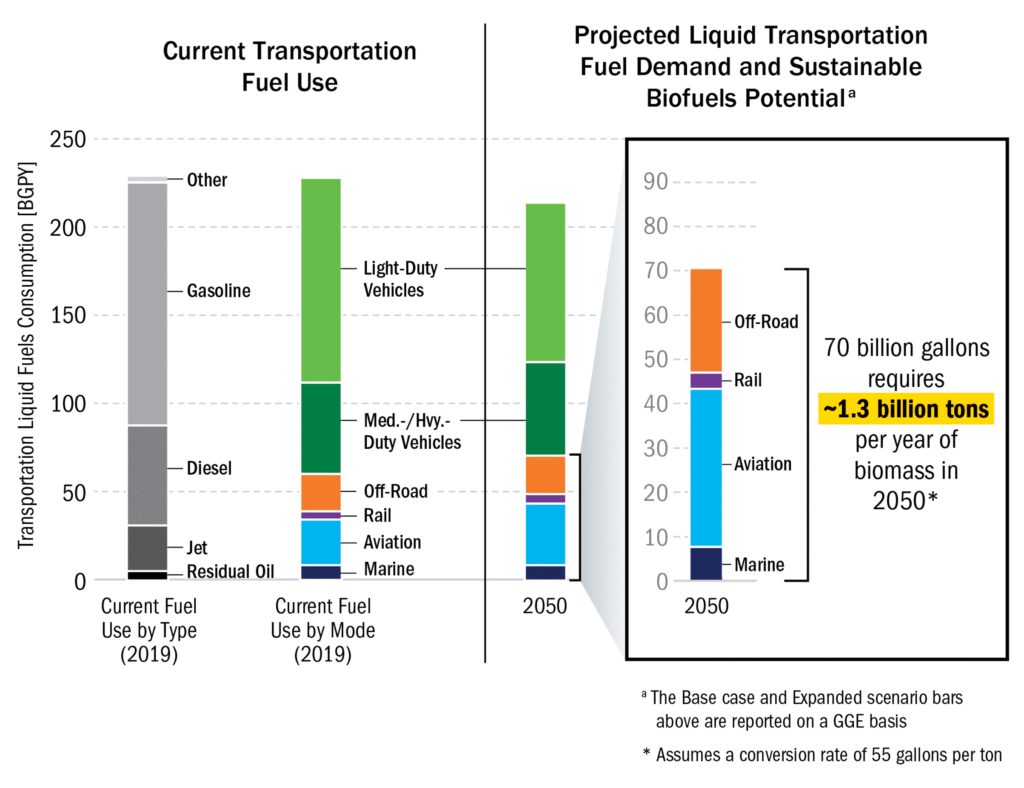
According to the report, which was created by 54 experts from 11 organizations, bringing on new biomass resources like algae would make 1.3 billion tons per year conservatively achievable (Fig. 1). This would be enough to produce 70 billion gallons of transportation fuel, making it feasible to support other hard-to-electrify transportation sectors like marine fuel.
Economic Promise Being Realized
Assuming a farm gate price of $70-130 per ton (prices being paid today), biomass crops could produce up to $20 billion in additional farm income and 500,000 new jobs, according to economic modeling presented during the session. However, yield, location, and transportation expenses all have a significant impact on profitability.
During the webinar, common misconceptions about the usage of “marginal land” were also challenged. The most widely held notion is that biomass crops thrive on economically marginal land. While biomass crops are often more cost-effective than traditional annual crops planted on marginal land, they yield even more on better farmland. As more domestic manufacturing develops for U.S. biofuels and bioproducts, biomass crops are seen as stable profit generators that complement annual grain crops.
New Regional Hubs and Policy Coordination
DOE’s plan to create regional hubs for biomass resources was presented by Damon Hartley. Through data sharing and concerted efforts, these hubs seek to lower risk, promote industry growth, and link producers with end users.
Sub-county land analysis, ecosystem service payments, and integrated landscape management will all be investigated in future studies to better match biomass production with both economic and environmental objectives.
Looking Ahead
The session concluded with a call for continued collaboration among researchers, farmers, and policymakers. As the U.S. moves toward a low-carbon future, the BT23 report and the insights shared in this session provide a roadmap for integrating biomass into the national energy strategy. The path forward will require innovation, investment, and a deep understanding of both the science and the people behind the land.
See the webinar on Youtube Matt Langholtz – Billion Ton Study Overview