


From Coal to Climate Smart: Switchgrass Projects Aim to Reclaim Iowa’s Low-ROI Farmland
As we prepare for the 2026 Biomass Webinar Series to kick off in July (register here), here is a refresher on the large Iowa switchgrass projects featured in 2025 Biomass Webinar Series.
Urbana, Illinois – In Chariton Valley, Iowa, switchgrass activities are expanding yet again. Nearly twenty years after the Chariton Valley Biomass Project demonstrated how farmers could stabilize their soil and their income using switchgrass to complement coal in power stations, new activities focused on bioproducts are now underway.
In this webinar, Bill Belden, a pivotal player in the initial and ongoing initiatives, lays out the history and future of switchgrass for energy and bioproducts. I
Pioneering switchgrass as a conservation crop on working lands
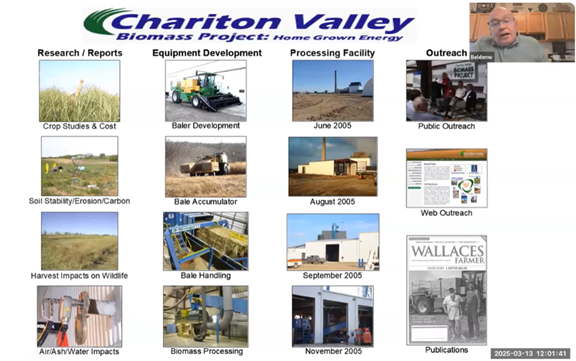
Bill was part of the original Chariton Valley Biomass Project was started in 1996 with the goal of co-firing switchgrass and coal at a 726 MW power plant. The project was permitted to grow and harvest switchgrass from Conservation Reserve Program (CRP) lands for several years to understand if set-aside farmland could be managed with conservation cropping systems that provided return to farmers while also protecting soil and water resources.
The project successfully established a farmer network with specialized equipment and two processing facilities were constructed that were used to supply switchgrass that generated heat and power at the Chariton Valley power plant. However, as natural gas and fracking changed the heat and power industry, the combination of low coal prices and a lack of regulatory incentives meant that by 2006, the project had been put on hold.
Although the project demonstrated that co-firing biomass could be successful, Belden pointed out that the market and policy environment of the early 2000s was not prepared for it.
Targeting switchgrass to bolster farm profit
Rather than walking away, Belden and partners turned lessons learned into actionable innovation. They developed new harvesting equipment, participated in U.S. Department of Energy (DOE) supply chain projects, and identified a surprising opportunity: 20% of Iowa farmland with low return on investment (ROI) could be ideal for perennial biomass crops like switchgrass.
Rather than targeting federal CRP acres, Beldenand colleagues began collaborating with the Iowa Dept. of Ag and Land Stewardship (IDALS) alongside county Soil and Water Conservation Districts to target conservation funding to high-risk corn/soy acres. Belden worked as part of a team that now includes FDC Enterprises, USDA/NRCS, IDALS, the USDA, Restoration Bioproducts, Stark Technologies, and Prairie Lands Bio-Products to develop switchgrass as a more stable, profitable option for those underperforming corn/soy acres.
Climate Smart Switchgrass takes root
The team was awarded $5M from USDA’s Regional Conservation Partnership Program (RCPP), in a project led by FDC Enterprises and used it to start the Climate Smart Switchgrass Initiative in 2023. They have been planting an additional 5,000 acres of switchgrass in Virginia and Iowa while providing growers with direct financial support during the establishment phase. The harvested biomass can then be sold through FDC Enterprises for erosion control products to provide farmer income beyond the life of the grant. A similar $9.8 M project is underway in Decatur, IL with some of the same team.
Depending on the funding source, farmers can sign up for 5 or 10-year contracts with full establishment cost coverage. Following the first two establishment years, a commercial contract will be offered to the landowners with guaranteed payments of $50 per ton of biomass from members of the project team and will go into biomass products developed by the project team.
More than biomass: water quality and soil health
There is more to this new initiative than energy. Reduced soil erosion, better water quality, and regenerative soil health are foundational environmental co-benefits of incorporating switchgrass into row-cropped landscapes. Additionally, there is a strong push to replace conventional wood-based materials with switchgrass in erosion control products like conservation socks. Biochar production is also anticipated from this initiative.
With assistance from scientists at Argonne National Lab and the University of Iowa, the project team is attempting to verify climate-smart claims; carbon intensity scoring is being developed using techniques from Lisa Schulte Moore’s team at the Iowa State University Bioeconomy Institute.
Hurdles and Hope
There are still obstacles in spite of the momentum. To enable a broader use of switchgrass-based materials in infrastructure, regulatory changes are required, particularly at the Department of Transportation to allow greater use of switchgrass erosion control products in highway construction projects. Belden acknowledged the fine balance between innovation and policy readiness and underlined the continuous effort to “build the market while building the product.”
Nonetheless, a solid basis is provided by Iowa’s state leadership and agency assistance. The objective is clear: to turn low-productivity land into a high-impact solution as switchgrass develops from an experimental fuel source to a climate-smart commodity.
Are you interested in joining future webinars like this one in the future? Register here to join us as we learn and grow together!
Link to webinar
Bill Belden – What’s Happening With Switchgrass in Iowa?
References
https://www.iowaswitchgrass.com/.
https://www.nrcs.usda.gov/programs-initiatives/regional-conservation-partnership-program.
https://ia-switchgrass-rcpp.com/.
https://www.restorationbio.com/.