


Illinois winter wheat enters spring in good condition
You can also read the article in Portuguese and Spanish
Wheat acreage in Illinois has trended downward for much of the past 50 years, declining from about 1.5 million acres in the 1970s to an average of approximately 570,000 acres between 2015 and 2022. Acreage rebounded in more recent years, averaging nearly 750,000 acres over the past five years, with 2026 acreage estimated at 720,000. This recent increase began with increases in wheat prices following the Russian invasion of Ukraine and has been sustained by outstanding yields. The average Illinois wheat yield from 2021 to 2025 was 83.8 bushels per acre, with a state‑record yield of 88 bushels per acre in 2025. Yields in recent years have come from improved genetics and management, with a very strong boost from dry weather in May and June each year.
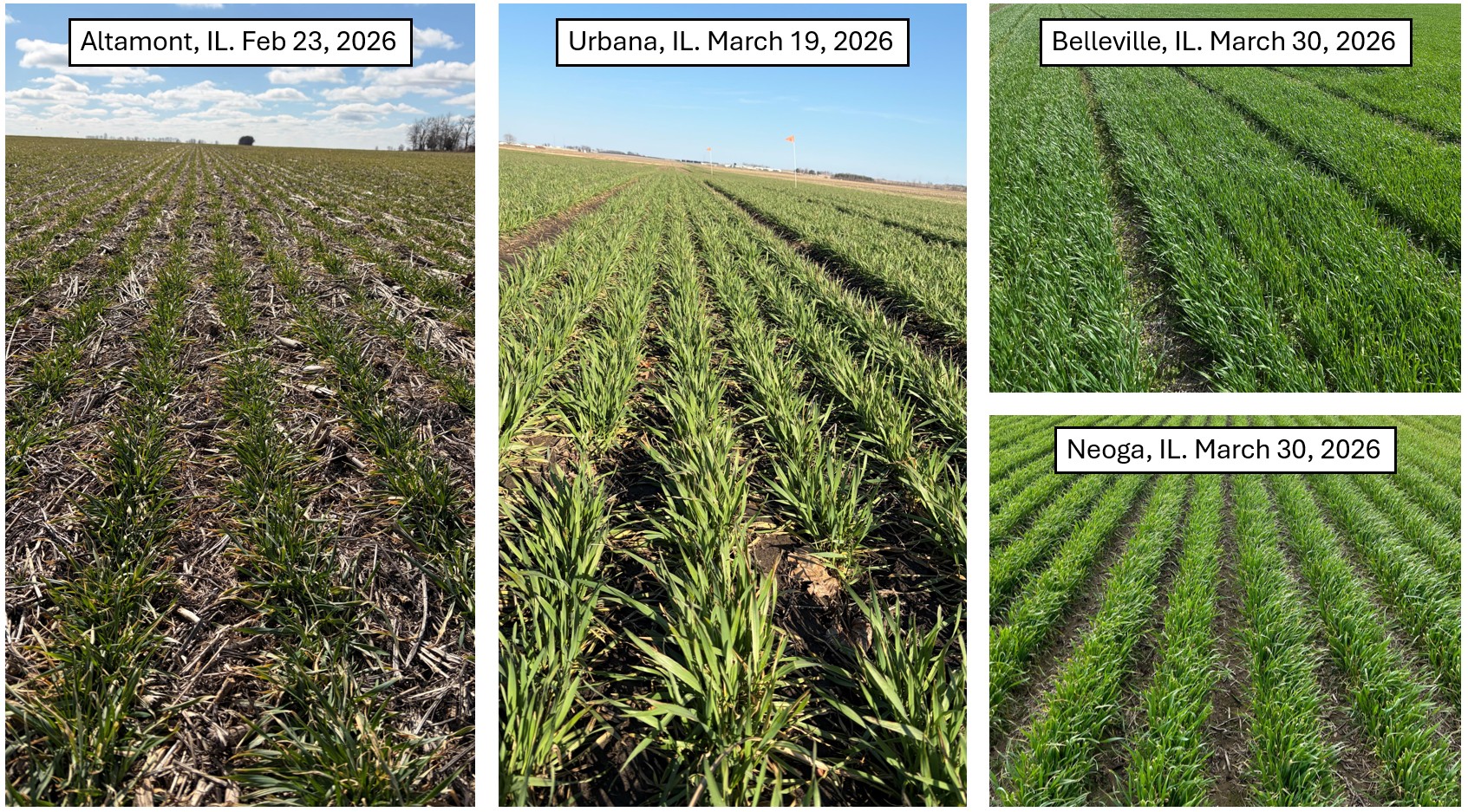
Wheat planting was completed more or less on time last fall, although emergence was delayed in some areas. Crop ratings in late November 2025 were 56% good + excellent, which is neither particularly high nor historically a reliable predictor of crop performance. Snowfall during winter helped protect the crop during cold periods, and wheat stands did not show widespread winter injury, although much of the state remained drier than normal into late winter. Above-normal temperatures in February promoted early greenup. March ended 6°F warmer than normal statewide and brought multiple precipitation events that improved soil moisture and supported vegetative growth and tiller development heading into April (Figure 1). The USDA-NASS crop progress report released today (April 6) rated Illinois winter wheat condition ratings at 72% good + excellent, 24% fair, and 4% poor or very poor. These ratings are slightly better than those reported at the same time last year, when the April 6, 2025, report showed 63% good + excellent and 35% fair. Overall, current ratings indicate that the 2026 wheat crop has come through the winter in reasonably good shape.
Nitrogen & Sulfur
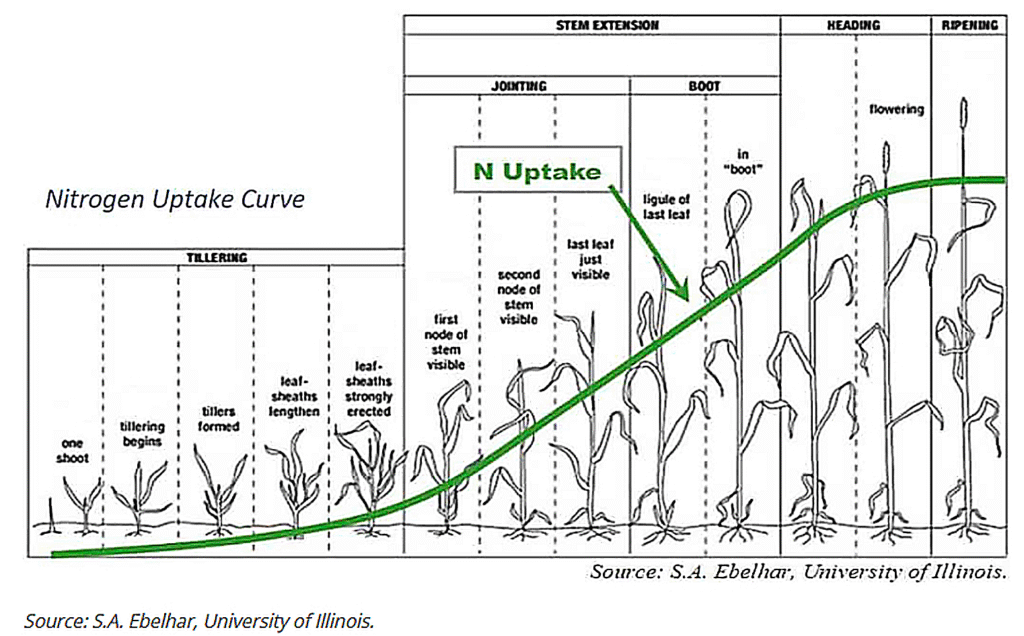
Spring topdress applications of nitrogen (N) have now been made in nearly all of Illinois by now. While yield potential has not yet been fully determined at this point, the timing of N availability becomes increasingly important as the crop enters stem elongation. This is particularly important for fields that have not yet received N or are intended to receive a second application. Research shows that the majority of N uptake in wheat occurs between Feekes 6 and heading (Figure 3)—a period that typically lasts three to four weeks in Illinois. This narrow window makes timely N availability critical, and any N deficiencies that develop after Feekes 6 must be corrected quickly to have a meaningful impact on yield. Although there is limited evidence that very early applications during dormancy provide agronomic benefit, applications made closer to greenup or during early stem elongation generally align better with crop N demand. Where wet conditions have occurred, nitrogen losses may have increased the likelihood of mid‑season deficiencies, reinforcing the importance of scouting and, in some cases, supplemental applications.
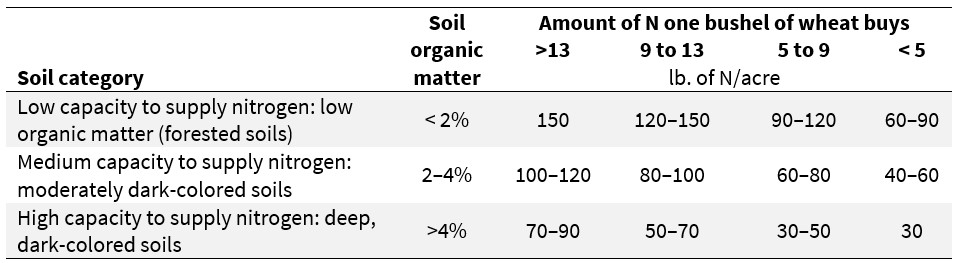
Most N is now applied as urea or UAN with streamer bars, which provide uniform coverage with minimal leaf injury. Regional differences in soil organic matter and crop N uptake patterns support higher N rates in southern Illinois than in central and northern regions. Nitrogen rates are best adjusted based on the wheat-to-N price ratio (i.e., $/bushel per $/lb-N). Table 1 provides guidelines for total spring N rates across soil categories and price scenarios, assuming no more than 30 lb N/acre was applied in the fall.
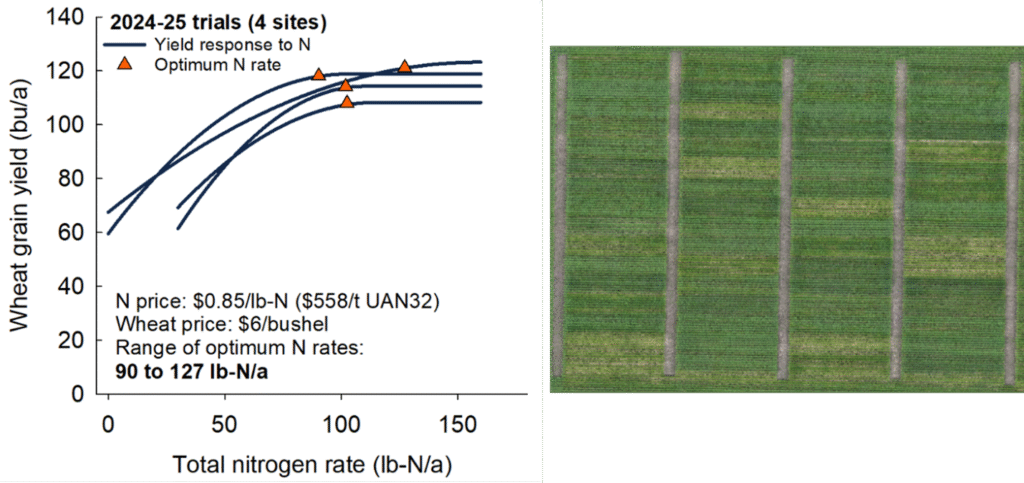
Split applications of N may alleviate the effects of N lost from earlier applications, though a second pass across the field does not always ensure higher yields compared to single applications at greenup. Nitrogen application at stem elongation (Feekes 6 to 9) is also an opportunity to apply sulfur. In 2024-2025 trials in Illinois, wheat response to sulfur ranged from 1 to 5 bushels on soils with 2-4% soil organic matter. We found no yield difference between the sulfur rates of 15, 30, and 45 lb S/acre. Figure 3 shows wheat yield response to N at four sites in the 2024-2025 growing season on high and medium N-supplying soils. Optimum N rates in Figure 3 were calculated using $6/bushel wheat and $.85/lb N prices, corresponding to a bushel of wheat buying 7.1 pounds of N (5 to 9 ratio range in Table 1). Higher recently observed optimum N rates may be explained by greater yields in these recent trials (108 to 121 bu/a at the optimum N rates) compared to supporting research which produced Table 1. Current statewide research funded by the Illinois Nutrient Research and Education Council is examining wheat response to nitrogen rate and timing, phosphorus sources, and sulfur rates across Illinois, with results to be used to sharpen Illinois Agronomy Handbook guidelines. Current sites this season are in DeWitt, Effingham, Monroe, Piatt, Pike, St. Clair, Warren, and Washington counties; the number of sites is set to increase in 2026-2027. Please reach out to John Jones (jones86@illinois.edu) if you are interested in hosting a site.
Spring growth and yield outlook
Tiller initiation slows to a stop before wheat plants enter the stem elongation stage (Feekes 6) when upright growth accelerates, and the first node is palpable above ground level. Fall-formed tillers tend to contribute more to yield than spring-formed tillers, but those that form in the spring can help compensate for lower plant stands. Wheat typically produces more tillers than heads, so inadequate tiller number is usually not a major concern in Illinois. Fields with complete or nearly complete ground cover as soon as growth begins after greenup should have sufficient tiller and (potential) head numbers. Forecasts call for warmer-than-normal temperatures over the next couple of weeks, which would keep crop development ahead of normal. Early-planted wheat should be at or reaching the Feekes 6 stage this week in southern Illinois, and by mid-April in central Illinois.
As we continue to monitor the Illinois wheat crop over the coming month, it is important to remember that yield prospects depend more on weather conditions in May and early June than on crop appearance in April. Although rapid canopy development is desirable, the grain-filling period is relatively short and highly sensitive to weather conditions following flowering. Dry conditions with adequate sunlight and moderate temperatures generally favor grain fill and yield, while extended wet periods can increase foliar disease pressure, complicate fungicide applications, and limit daily sunshine amounts to lower yields and grain quality. Flowering typically begins in late April in southern Illinois, the second week of May in central Illinois, and the third or fourth week of May in northern Illinois. Averaged over the past five years (2020-2024), Illinois wheat reached 50% headed by May 10.
June weather also plays a critical role in determining final yield. Yields are generally good if we have about three weeks of favorable conditions (limited rainfall producing high sunlight amounts and low humidity levels) during grain filling, and when leaf area remains green and healthy during this period. Once grain filling is complete, wheat dries down rapidly, with kernel moisture declining from about 30% at hard dough (Feekes 11.3) to 15% during ripening. Under very warm, dry, and sunny conditions in mid- to late June, it is not unusual for kernel moisture to decline by as much as 10 percentage points in a single day.