


Corn leaf aphids – when to scout and what to expect
As our earlier planted corn begins to tassel, folks who have experienced corn leaf aphid outbreaks the last couple of years should begin scouting. This insect remains an uncommon pest; however, several hybrids were affected both during the rather large outbreak we experienced in 2024 in central Illinois and in 2025, when overall corn leaf aphid numbers were much closer to what we see in a typical year. Most pest aphids are sensitive to differences in cultivar, so it’s no surprise that some hybrids are more susceptible than others to corn leaf aphid.
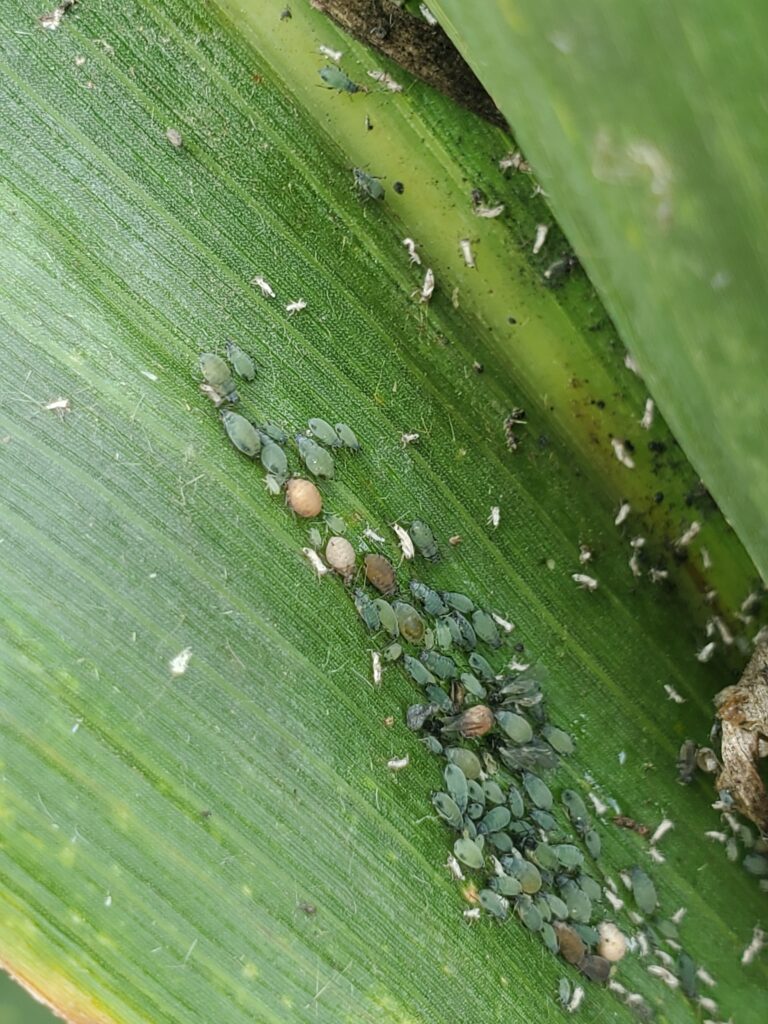
Corn leaf aphids develop and reproduce quickly on corn in the late vegetative and early reproductive stages, where much of the crop in Illinois currently stands. Severe infestations can interfere with kernel formation and, in some cases, have dramatic effects on yield. While the cost of missing an infestation can be high, the good news is that relatively few fields are likely to be affected. In addition to hybrid sensitivity, later planted fields tend to be more vulnerable. In a normal year, most of our corn tassels before the aphids really get going in corn; when that happens, isolated colonies are quickly subdued by lady beetles, fungal pathogens, parasitoid wasps, and other natural enemies. (I should note, this article is intended only as a scouting alert – I have not received a single report of corn leaf aphids yet in 2026. At this point, I have no reason to think this will be anything other than a “normal” year where few if any fields are seriously affected).
If colony formation (dime-sized or larger groups of wingless aphids) is evident on around half of the plants from the late vegetative stages through tassel, an insecticide application is warranted. Good coverage can be difficult to achieve in canopied corn, but is essential for the contact insecticides that we are most likely to use. The good news is that the vast majority of fields will not need an insecticide application for this occasional, sporadic pest.
Nick Seiter, Field Crop Entomologist | nseiter@illinois.edu | 812-593-4317