


Evaluating soybean performance in conservation systems – project report
You can also read the article in Portuguese and Spanish
Introduction
Recent dust storm events in central Illinois and across the Midwest have renewed attention on soil conservation, especially after the tragic May 2023 event near Springfield that caused an 80-vehicle pileup, eight fatalities, and dozens of injuries. These incidents highlight that soil loss is not only an agronomic issue but also a public safety and environmental concern. Reduced tillage and cover crops are well-established practices to reduce wind and water erosion, and many Illinois growers are considering them. Yet, these systems are often associated with potential yield penalties.
Soybean establishment in high-residue systems, particularly after high-yielding corn or cereal rye cover crop, can be challenging. Heavy residue can slow soil warming and drying in the spring and around planting time. These cooler, wetter conditions slow the mineralization of organic matter, which in turn can limit early-season N and S availability. This situation can be exacerbated in no-till and cereal rye cover crop systems because the residue can immobilize some of the soil N that would otherwise be available to support early soybean development.
This project began in direct response to these challenges and was made possible through funding from the Illinois Soybean Association. Our primary goal was to evaluate whether growers can maintain productivity and profitability while using reduced tillage and cover crops, systems that protect soil but are often perceived as risky. A second objective was to understand whether starter fertilizer (nitrogen + sulfur) could offset early-season challenges in these systems, such as cool soils, heavy residue, and slower early growth.
Methodology
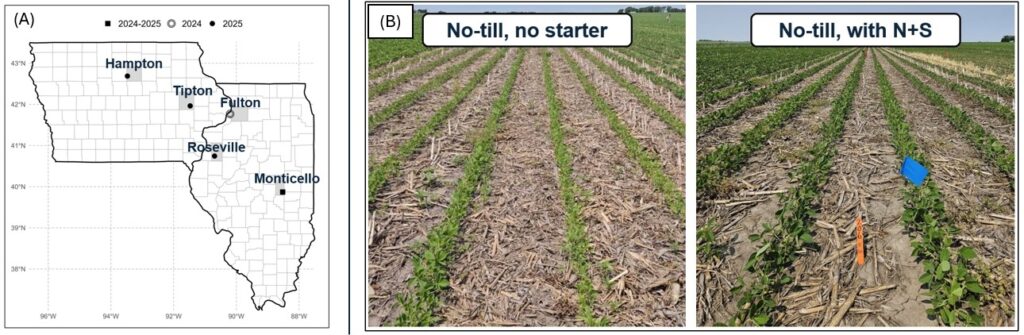
In 2024 and 2025, we conducted field trials at six sites across central Illinois and north-central Iowa (Figure 1A). All sites were located on productive soils with 3.7–4.2% organic matter. Grain yield was measured at the Iowa sites, while the Illinois sites also included detailed plant and soil measurements to better understand treatment effects during the growing season. The study evaluated four management systems: conventional tillage (CT; fall chisel plus spring field cultivation), fall strip-tillage (ST), no-tillage (NT), and no-tillage with a cereal rye cover crop (NT+CR). Each system was paired with three starter fertilizer strategies: an unfertilized control (UTC, no starter), 15 lb N/ac, and 15 lb N/ac + 10 lb S/ac.
Cereal rye was drilled after corn harvest in 7.5-inch rows at 40-50 lbs/acre and terminated at about two weeks before soybean planting; targeting 1,000 to 1,200 lbs/acre of dry biomass at termination. Soybeans were planted in 30-inch rows at 140,000-150,000 seeds/acre. The starter fertilizer was applied at planting in a 2×2 band. The N was applied as UAN (32%), and the N+S treatment used a blend of UAN and ATS (12-0-0-26S). Soybean biomass (V4) and leaf tissue (R2) were collected to assess nutrient status and treatment effects across the growing season.
Results
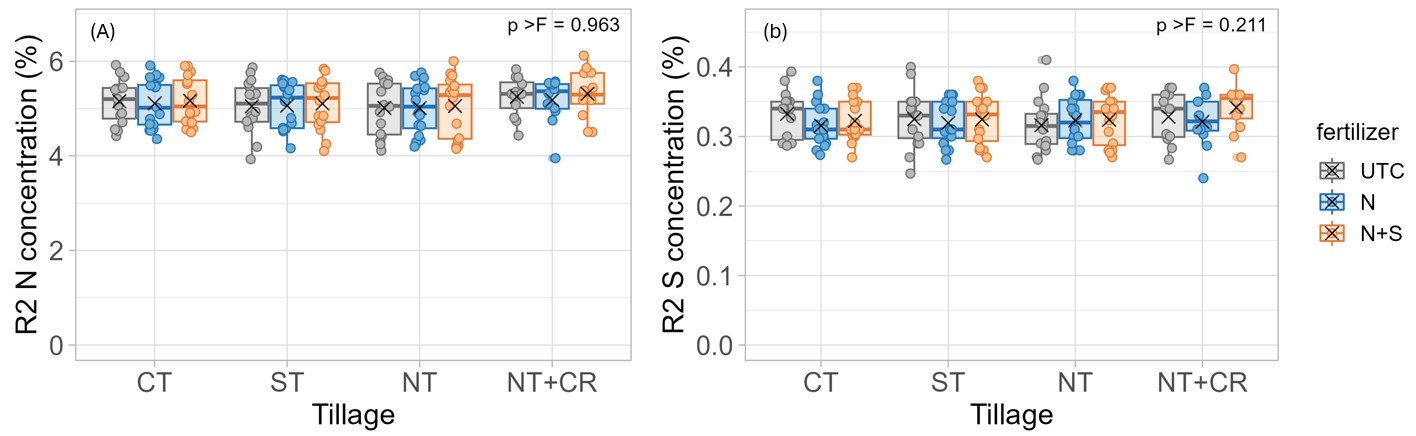
Across our Illinois locations, soybeans generally showed an early-season response to starter fertilizer. Plants that received either N or N+S tended to have a greener canopy and produced greater early leaf area compared to the unfertilized control (Figure 1B). When averaged across the Illinois sites, starter fertilizer increased V4 soybean biomass by approximately 12% (data not shown). These early differences, however, did not persist as the season progressed. By the R2 growth stage, leaf tissue analysis showed that N and S concentrations were not statistically different among all treatments, and most values exceeded established sufficiency levels in the literature (4.3% for N; 0.265% for S) (Figure 2). These results indicate that soybeans were able to meet their nutrient needs through biological nitrogen fixation and soil organic matter mineralization, even in the absence of starter fertilizer.
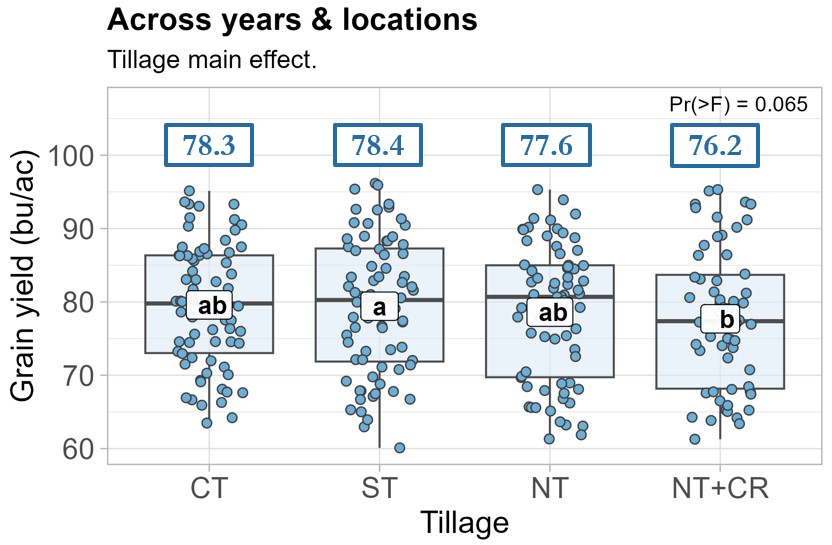
Soybean grain yield ranged from roughly 60 to 95 bushels per acre across the six locations and two study years (Figure 4). Despite the early biomass increase, starter fertilizer did not significantly increase seed yield across any of the tillage or cover crop systems. While a few sites showed a non-significant 2-5 bushel/acre increase with starter fertilizer in NT +CR, these responses were not consistent across locations or years (data not shown).
Yield differences among tillage systems were also relatively small. When averaged across the six site-years, CT and ST produced about 78.4 bushels/acre. No-till averaged slightly lower at 77.6, and NT+CR averaged 76.2 bushels/acre. In practice, our results show that soybeans grown under reduced tillage and cereal rye systems performed similarly to soybeans grown under CT.
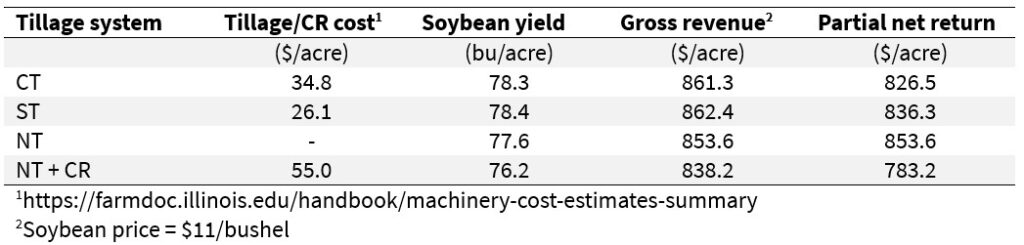
When economic considerations are included, differences in partial net return became more pronounced due to the costs associated with each tillage system (Table 1). Based on estimated field operational costs and assuming a soybean price of $11/bushel, the NT returned the highest partial net profit, followed by ST and CT. The NT+CR had the lowest partial net return due to the higher cost of cover crop management, estimated at $55/acre. It is important to note that cover crop expenses can be substantially offset by available state and federal cost-share programs, and reduced tillage may offer profitability advantages in years with low commodity prices.
Looking ahead
This project will continue into its third year (2026). The experiments near Monticello in Piatt County, initiated in the fall of 2023, remain in place to allow us to track medium-term responses as the soil, residue levels, and nutrient dynamics change under reduced tillage and cereal rye cover crop. These medium- to long-term data will provide valuable insights into how soybean performance and nutrient dynamics shift over time in conservation systems; information that will help growers committed to improving conservation without sacrificing yield potential.
These findings should be considered preliminary. More data will be released once the trial is completed.