


Double-crop Soybean Management Practices – Project Report
You can also read the article in Portuguese and Spanish
Introduction
There is a growing interest in wheat/soybean double-cropping systems in Illinois, extending into parts of central Illinois where wheat acreage has been limited in recent decades. USDA-NASS survey estimates that 60-80% of Illinois wheat acres are double-cropped with soybeans. Implementing this system in central and northern Illinois has been constrained primarily by low wheat acreage and by later wheat harvest, which often delays soybean planting until early to mid-July. Such late planting generally results in shorter soybean plants with fewer lateral branches and nodes, which lowers soybean yield potential per plant.
Two agronomic factors that may improve the productivity and profitability of double-crop soybeans are maturity group (MG) selection and seeding rate. Selecting a variety that is 0.5 to 1.0 MG earlier than a full-season cultivar may lower the risk of fall frost damage. There is some evidence that current earlier-maturing varieties may not have much lower yield potential than mid-maturing varieties when both are planted early, but we do not know if this is the case when planting is delayed in the double-crop system. Increasing the seeding rate is also recommended in some states for late-planted/double-crop soybeans, to promote faster canopy closure and maximize light interception. In Kentucky and Ohio, Extension agronomists recommend harvest plant populations between 130,000 and 150,000 plants/acre for double-crop soybean.
In addition, wheat can remove substantial soil nitrogen (N) with grain harvest; a 100-bushel wheat crop removes approximately 190 lb N/acre. Although soybean typically meets most of its N requirement through biological N fixation, it is unclear whether supplemental N (particularly as a starter fertilizer) may benefit double-crop soybean following wheat.
Methodology
Field trials were conducted near Hammond in Piatt County during two growing seasons to evaluate the effects of seeding rate, MG, and starter fertilizer on double-crop soybean grain yield (Table 1). Trials were on silt loam and silty clay loam Mollisols with 3.7% organic matter. Treatments consisted of a 3-way factorial combination of: four seeding rates (140,000 to 260,000 seeds/acre, in increments of 40,000); two varieties with MG ratings of 3.0-3.2 and 3.6-3.8; and two fertility levels (none vs. N+S), for a total of 16 treatments. The latter (3.6-3.8 MG) varieties are commonly-grown, locally-adapted varieties, and hereafter referred to as ‘full-season’; and the 3.0-3.2 MG are referred to as ‘early-season’. Treatments were replicated four times. Plots were 20 ft wide by 500 ft long.
Double-crop soybeans were no-till planted in 15-inch rows soon after wheat harvest. Starter fertilizer was applied at planting in a 2×2 band, supplying 26 lb of N and 11 lb of sulfur (S) using a blend of UAN (32-0-0) and ATS (12-0-0-26S). Weeds were controlled with pre- and post-emergence herbicide applications. Seed yield was measured from the center of each plot using a field-scale combine with a calibrated yield monitor and GPS tracking system. All yields were adjusted to 13% moisture.

Results
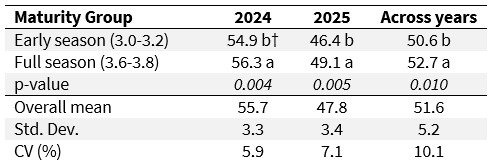
Double-crop soybean yield averaged 55.7 and 47.8 bushels/acre in 2024 and 2025, respectively. Maturity group had a small but consistent impact on double-crop soybean yield (Table 2). Full-season varieties (MG 3.6-3.8) yielded about 4% (2.1 bushels/acre) more than early-maturing varieties (MG 3.0-3.2), averaged across seeding rate and fertility treatments. The yield advantage of full-season varieties was likely associated with a longer reproductive period, as no fall frost injury was observed during either year of the study. These results are consistent with previous research indicating that, when frost risk is minimal, the longest adapted MG for the region often maximizes yield potential in double-crop soybean systems.
Seeding rate response by maturity group
Across years and fertility treatments, double‑crop soybean yield response to seeding rate differed by soybean maturity (Figure 1). Yield of early‑maturing varieties increased across the entire range of seeding rates, reaching a maximum (52.3 bushels/acre) at about 252,000 seeds/acre, just below the maximum seeding rate used. In contrast, yield response to seeding rate for full‑season varieties increased at lower seeding rates, but reached a maximum at about 207,000 seeds/acre, with no additional yield increase from further increases in seeding rate. Maximum yield for full‑season varieties was estimated at 53.4 bushels/acre. These results indicate that early-maturing varieties may require higher seeding rates to achieve yields similar to those of full-season varieties. It is also clear that seeding rates may need to be at or above 200,000 for double-cropped soybeans.

Effect of starter fertilizer
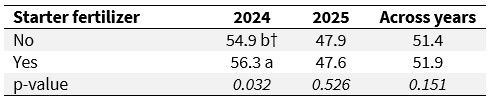
Starter fertilizer application (N+S) increased double-crop soybean yield in 2024 but not in 2025 or when averaged across years. The yield response observed in 2024 was only 1.4 bushels/acre (2.6%), on average, and was unlikely to offset the additional input cost. Although wheat removes substantial amounts of N with grain harvest, wheat N uptake typically concludes by early June before ripening. As a result, a considerable portion of soil N mineralization may have occurred between wheat harvest and double-crop soybean planting, increasing soil N availability to the subsequent soybean crop. In addition to biological N fixation, mineralized soil N supplies substantial amounts of N to soybeans. Overall, these results suggest that starter N and S fertilization was not a consistent yield-enhancing practice for double-crop soybean in central Illinois.
This was supported by, and in collaboration with, the Illinois Agricultural Experiment Station, the Illinois Fertilizer & Chemical Association (Dan Schaefer), and Eric Miller (producer and landowner in Piatt County).
These findings should be considered preliminary. Similar trials across years and locations are ongoing to strengthen regional recommendations.