


Update on corn planting progress and prospects
You can also read the article in Portuguese and Spanish
April ended with temperatures averaging 4 to 8 degrees above normal in Illinois, and despite several rainfall events across the state, planting progress continued to advance. Conditions have generally allowed for steady fieldwork, with USDA-NASS reporting 3.5 to 4.8 days suitable for fieldwork during each of the last four weeks, which has been enough to get a lot of planting done.
The first week of May, however, brought a shift toward cooler and wetter conditions. Temperatures ranged from 3 to 8 degrees below normal, with nighttime lows dropping into the 30s across parts of central and northern Illinois, including 27°F in Rockford and 32°F in Charleston. Rainfall varied across the state, from less than 0.1 inches in northwest Illinois to more than 2.5 inches in east-central regions, leaving standing water in some fields, including in parts of Champaign County.
Even with this recent slowdown, Illinois soybean is ahead of most of the Corn Belt, with 57% of the soybean crop planted by May 10, up 11 percentage points from the previous week. This is also well ahead of both last year (48%) and the five-year average (47% for 2021-2025). Corn planting has also progressed at a near-normal pace, with 54% planted by May 10, up 16 percentage points from last week.
As a result of early planting, soybean emergence reached 31% by May 10, compared to 18% for the five-year average, while corn emergence reached 30%, compared to the 23% for the five-year average. Temperatures have fluctuated considerably in recent weeks, however, with daytime highs ranging from the 40s to the 80s and nighttime lows from the 20s to the 50s. This variability meant uneven accumulation of growing degree days (GDD), which in turn resulted in a wide range in emergence timing, both within and across fields, from about one week to more than two weeks in some cases (Figure 1). Such variation is common under cool conditions, and is not necessarily a cause for concern, as long as the final emergence percentage is adequate and reasonably uniform. Under cooler temperatures, the emergence process simply takes longer, and that greatly increases the variation in emergence time; it may take four or five days from the first plants emerging to the last ones within a field. In contrast, when conditions are warm, and 15 or 20 GDDs accumulate per day, emergence may be completed within 24 to 48 hours. When GDD accumulation is in single digits, however, emergence can easily take 3 to 4 days. In other words, when temperatures are lower than normal, we can’t trust the emerge-within-48-hours-or-become-a-weed “rule” that some like to promote.
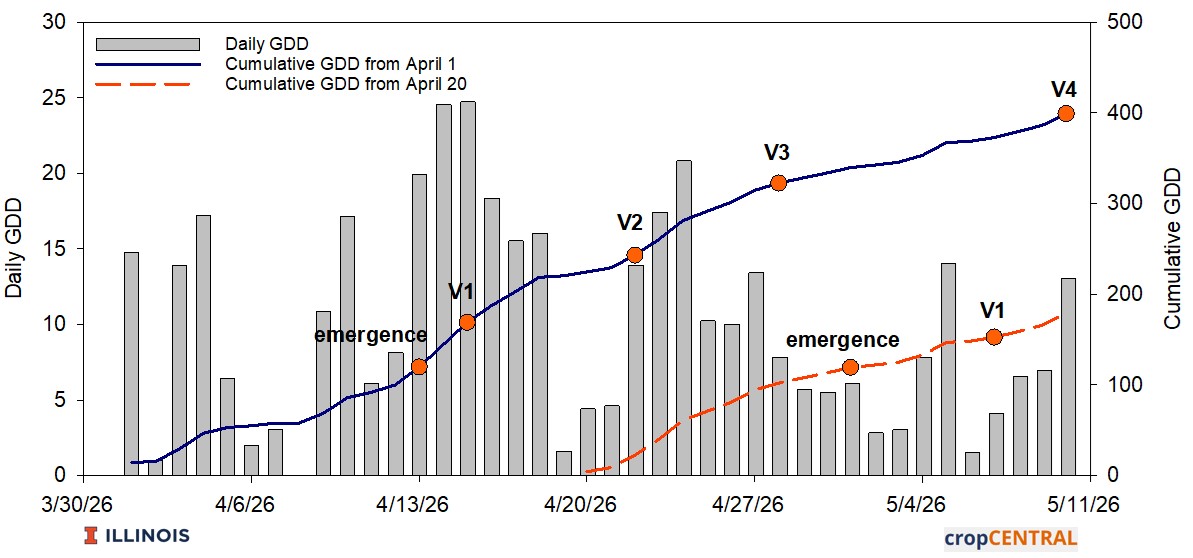
Corn plants that emerge later tend to remain behind their neighbors and contribute less to yield, largely because they are less competitive for light, water, and nutrients. These later-emerging plants do not normally end up as “weeds” as they will not reduce the yield of the surrounding plants; in fact, when conditions are favorable, the earlier-emerging (bigger) plants can partially compensate by producing larger ears. We also need to consider the cause of uneven emergence: if it is caused by factors such as seedling disease, soil crusting, waterlogging, or low seed vigor, the effects can last throughout the season and result in yield loss.
As planting continues, it’s worth keeping one key point in mind: planting date matters, but planting conditions matter just as much. We often talk about the benefits of early planting for maximizing yield, but those benefits depend on getting the crop established well. Planting into soils that are too wet or otherwise marginal can reduce stand, slow early growth, and limit yield potential. In many cases, waiting a few days for soils to become fit can lead to better results than planting earlier into less favorable conditions. Wet soils can lead to sidewall compaction, poor seed-to-soil contact, and restricted rooting, all of which can affect crop establishment. That’s why “fit soil conditions” should remain the priority, even as the calendar advances.
In the unlikely event that May turns out to be warmer and drier than normal (more like a typical June), this could set up a season with record planting and crop emergencies. While yield potential does begin to decline as planting moves later into May, we should be optimistic, and chances for a good crop remain high as long as planting can continue at a steady pace and is followed by more typical weather patterns. As we discussed in a previous article, both corn and soybean crops have benefited from a warm, relatively dry June over the past four years, which allowed for good root development, canopy growth, and stand establishment, followed by timely rainfall later in the season.
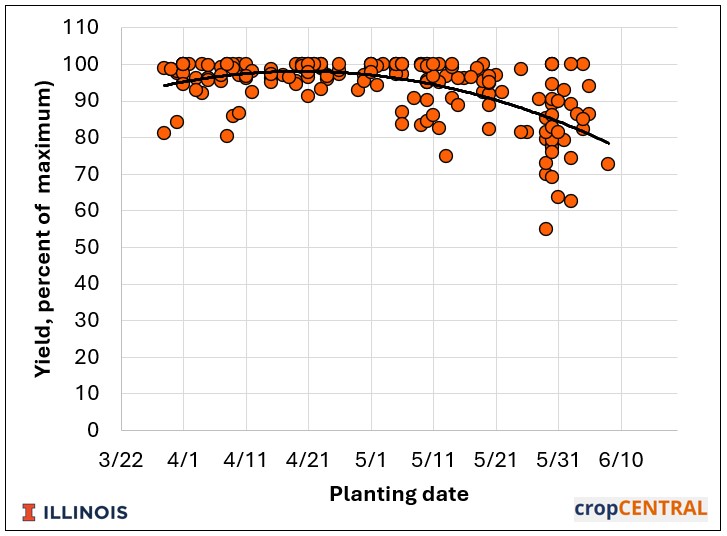
We’ve been running planting date studies at multiple sites in Illinois since 2007; a total of 45 trials between 2007 and 2025. One lesson we can take from this long-term dataset is that delayed planting into mid-May does not mean “game over” in terms of yield potential. Our data shows that corn planted by the end of April typically maximizes yield potential (Figure 2). By May 15, yields are reduced by about 7% (or 15 bushes/acre), and losses increase to about 12% (or 26 bushels/acre) by May 31. Yield losses become larger beyond that point, reaching 21% by June 8.
Overall, the 2026 planting season in Illinois is off to a strong start, with good progress and generally good early establishment. There have, however, been some reports of frost injury in early-planted fields. This included our planting date trial this year in Monmouth, where soybean planted on March 25 was at the VE stage when a freeze event occurred around April 20. In some other fields, this resulted in visible injury damage, particularly in low-lying areas. Since then, some stands have recovered, and there does not appear to have been very much replanting.
Our hope is that warmer temperatures in May will help both dry soils between rainfall events and promote rapid crop growth after emergence. As usual, weather conditions later in the season (especially rainfall during pollination) will play a major role in determining final yields in 2026.