First Southern Rust Report of 2026 in Illinois: What Corn Growers Should Know
Southern rust of corn, caused by the fungus Puccinia polysora, has now been confirmed in Illinois for the 2026 growing season. The first report was received on July 23 from Williamson County in southern Illinois.
This confirmation indicates that southern rust spores have reached the state and that corn growers and agronomists should begin scouting, particularly in fields with susceptible hybrids that have not yet reached the later reproductive stages. The disease can develop rapidly under warm, humid conditions, so early detection is important when evaluating whether a fungicide application may protect yield.
Recognizing Southern Rust
Southern rust produces small, orange to light-brown pustules typically found on the upper surface of corn leaves. These pustules are powdery and can appear in dense clusters, especially during warm and humid conditions (Figure 1).
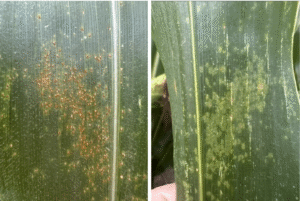
Figure 1. Southern rust symptoms on the upper and lower surfaces of a corn leaf collected in Williamson County, Illinois, on July 23, 2026. Numerous small, orange pustules are concentrated on the upper leaf surface (left), while few to no pustules are visible on the corresponding lower surface (right), a characteristic useful for distinguishing southern rust from common rust.
Do Not Confuse Southern Rust with Common Rust
Southern rust can be confused with common rust, which is frequently observed in Illinois cornfields. Common rust, caused by Puccinia sorghi, generally produces larger, elongated, reddish-brown pustules on both the upper and lower leaf surfaces. The pustules also tend to be more scattered.
Southern rust pustules are typically smaller, lighter orange, more densely clustered, and concentrated primarily on the upper leaf surface. However, visual identification can be difficult, particularly when symptoms are beginning to develop. Suspected samples should therefore be sent to the University of Illinois Plant Clinic for confirmation.
Common rust is widespread in Illinois but rarely causes economically important yield loss and generally does not require fungicide management. Southern rust is less common because the pathogen does not overwinter in Illinois and must be carried northward each season by windborne spores.
Southern rust can be considerably more damaging than common rust when it arrives early enough to affect grain fill. The pathogen uses nutrients from living leaf tissue, reduces the plant’s photosynthetic capacity, and may cause premature leaf death when disease pressure is high.
Submitting Samples to Confirm Diagnosis
Because southern rust and common rust can look similar, especially in early stages, identifying the correct disease in the field can be challenging. If you suspect southern rust in your corn, submitting a sample to the University of Illinois Plant Clinic is the best way to confirm the diagnosis.
Submission details and form: https://extension.illinois.edu/plant-clinic
Tracking the Spread
To keep up with real-time disease reports, use the Crop Lookout tool from the Crop Protection Network. This tool maps confirmed cases of southern rust (Figure 2) and other crop diseases across the U.S. and Canada.
Access it here: https://cropprotectionnetwork.org/crop-lookout
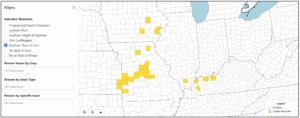
Figure 2. Counties with confirmed reports of southern rust of corn as of July 24, 2026, according to Crop Lookout.
Management with Fungicides
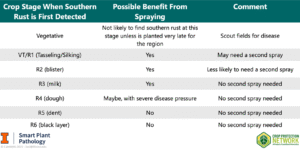
Timely application of fungicides with multiple modes of action between the VT and R3 stages has been shown to reduce disease severity and protect yield. If southern rust is not observed until R3, the application can be delayed until then, and a second spray is typically not needed (Table 1). For information on the efficacy of specific fungicides against southern and other foliar diseases, farmers can consult the Fungicide Efficacy for Control of Corn Foliar Diseases table available through the Crop Protection Network.
Table 1. Guidance on potential benefits of fungicide applications when southern rust is first detected at different corn growth stages.