


Kudzu bug found in Illinois
The kudzu bug, an invasive insect that feeds on kudzu and can be a pest of soybean, was recently found in southern Illinois in kudzu patches in Jackson and Pope Counties. While new to Illinois, kudzu bug has been in the U.S. since at least 2009. Like many invasive insects, it spread rapidly and was often found at extraordinarily high densities in the first few years after its arrival, but has since “settled down” and become an occasional pest of soybean in the southeastern U.S. (You can see its current distribution here). An upcoming fact sheet will cover the biology and pest status more broadly (and will be shared through these pages when it becomes available), but here I hope to focus on its identification and potential impact to soybean.
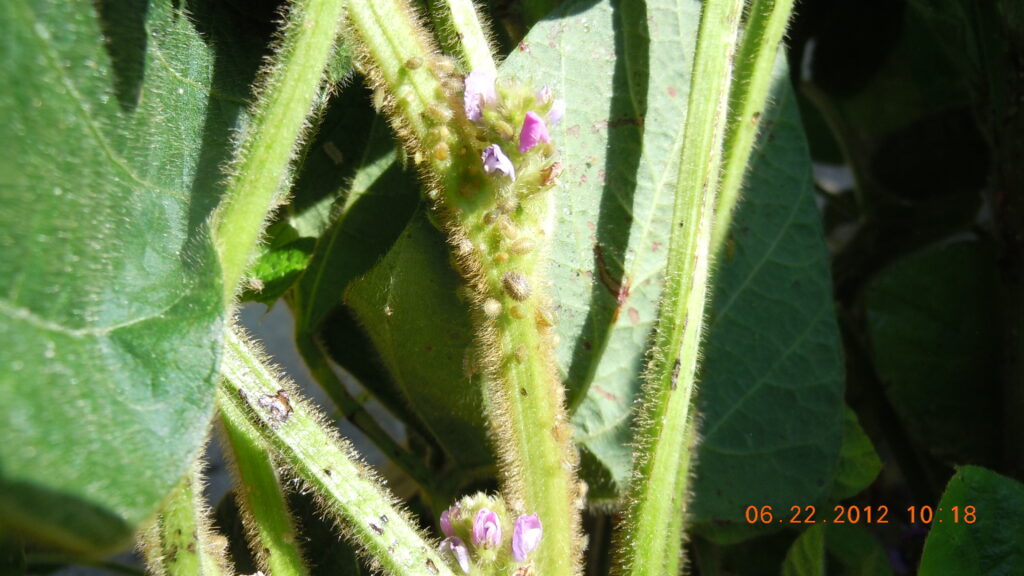
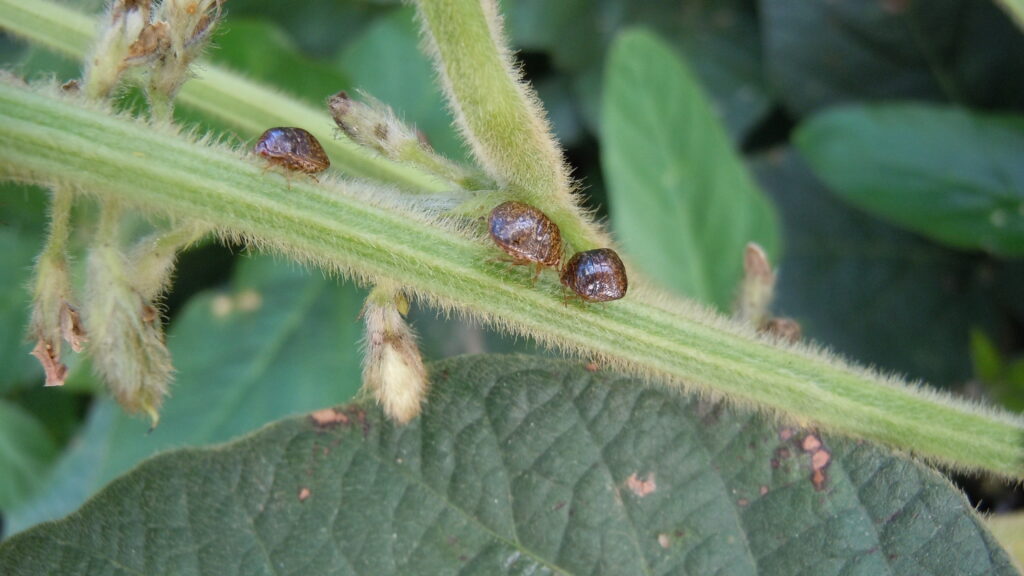
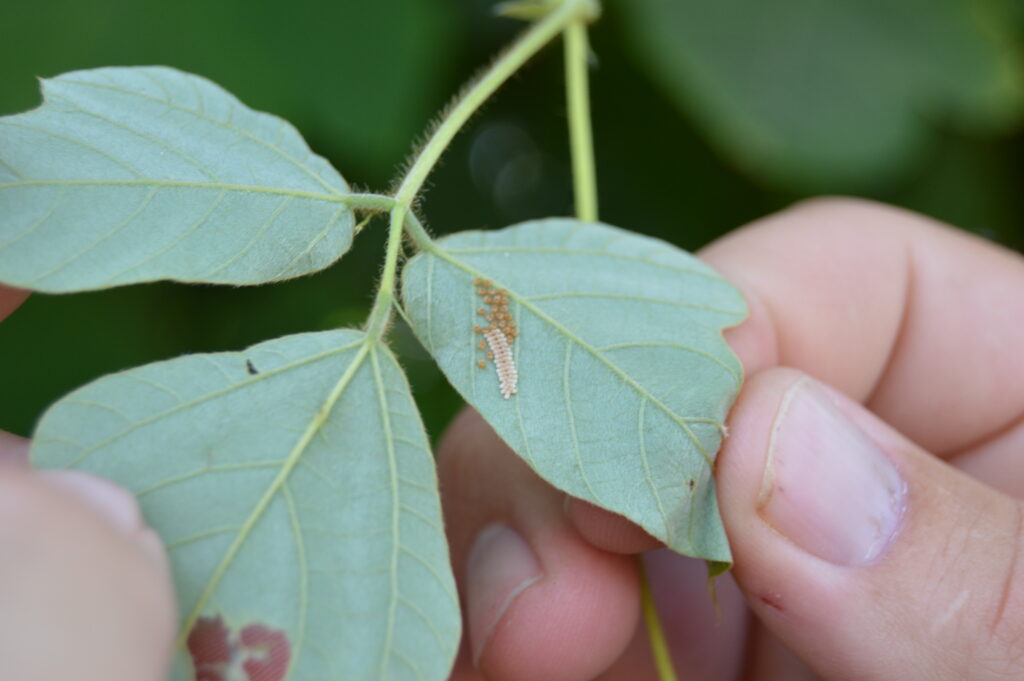
Identification. Kudzu bug is a distinctive insect. The adult is pea-sized with an overall trapezoidal shape and an olive color (Figure 1). Its wings are covered by a hardened, hinged plate known as a “scutellum.” This structure causes kudzu bugs to superficially resemble beetles, but they are sucking insects more closely related to stink bugs (order Hemiptera, family Plataspidae). The immature kudzu bugs (hereafter referred to as “nymphs”) are oval-shaped and hairy and, like the adults, tend to congregate on plant stems where they feed on sap, often leaving dark lesions (Figure 2). In addition to soybean and kudzu, wisteria and some other legumes can be hosts. (They do not, however, use alfalfa or clovers as host plants). The eggs are laid in parallel rows, often on the undersides of leaves (Figure 3).
Injury to soybean. Kudzu bugs feed on plant sap, draining the plant of fluids, sugars, and other nutrients and causing indirect yield loss. It takes relatively high numbers of kudzu bugs to reduce yields in an economically meaningful way, and the nymphs are particularly important; our colleagues in the southeastern U.S. recommend an insecticide only if you reach an economic threshold of one kudzu bug nymph per sweep (i.e. 25 nymphs in a 25-sweep sample) when using a sweep net. At that threshold, multiple nymphs would be easy to find visually on just about every plant. Serious yield losses are possible with this pest, but the insect numbers must be excessively high for this to happen.
Likely impact in Illinois. As kudzu bug has moved through the southeast, it has become apparent that its impact is greatest in areas with a lot of kudzu. Kudzu is a preferred host that is available throughout the insect’s development and can support the development of incredible numbers of kudzu bugs. In areas like eastern Arkansas (where kudzu is less common, soybeans are plentiful, and the insect has been present since 2015), it has been rare for kudzu bugs to reach damaging levels. Among other natural enemies, it is highly susceptible to Beauveria bassiana, a common fungal pathogen that infects and kills insects and can reduce a large kudzu bug population to nothing in a matter of days. Even in states like Alabama, Georgia, and South Carolina where kudzu is a major part of the land cover, kudzu bug has become a sporadic, occasional pest in the years since its initial invasion. Given the relatively small amount of kudzu in southern Illinois, it would be surprising if kudzu bug becomes a major problem for us in soybean. That said, we will be on the lookout for this new-to-us soybean pest and will report any developments. If you suspect you have found kudzu bug, please a report that include detailed information including, location, host plant and a photo for confirmation to invasives@illinois.edu.
Author: Nick Seiter, Field Crop Entomologist nseiter@illinois.edu (812) 593-4317