


More pink soybean stem structures: Clonostachys rosea, a commonly found late-season soybean fungus
At the end of the growing season, the Plant Clinic frequently receives soybean samples with pink/orange/white fungal growth on the lower stems and crowns (Figures 1 and 2). Based on the color, growers often assume it is a Fusarium species and may be concerned specifically about Fusarium virguliforme (cause of sudden death syndrome) and the various species that can cause Fusarium wilt and root rots. Some producers mistakenly identify it as red crown rot (caused by Calonectria ilicicola) due to the red-orange coloration and location near the base of the stem.
Because these structures are found at the end of the growing season on senescing tissue, and because they do not produce spores characteristic of common crop pathogens, we usually associate them with decomposer (saprophytic) fungi. Recently, the Plant Clinic identified the fungus producing these structures on soybean samples using spore morphology and DNA sequencing. Both the spore morphology and the DNA sequence identify the fungus as Clonostachys rosea.
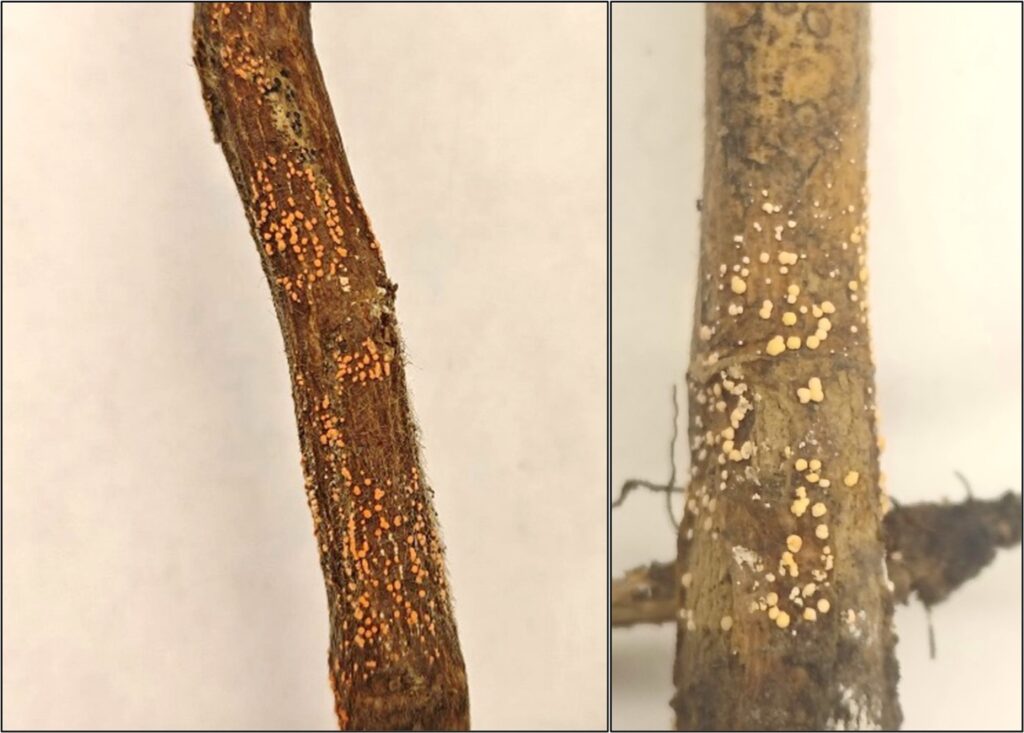
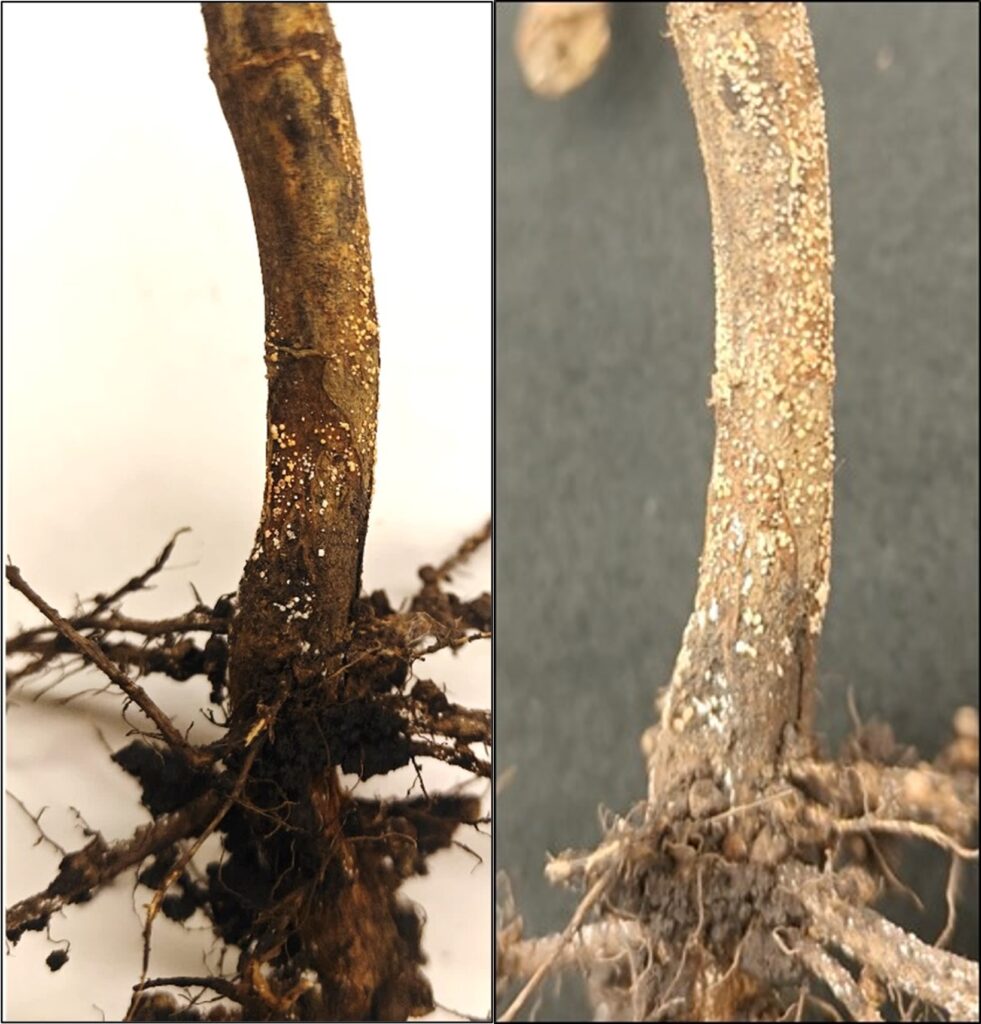
Clonostachys rosea is a commonly found soil-borne fungus that has been reported across the globe [1]. It is usually found in association with other fungi [2]. Although C. rosea was reported as a cause of soybean root rot in Minnesota in 2012 under experimental conditions [3], its overall impact on soybean production remains uncertain. Conversely, this fungus has also been studied for its potential as a biological control agent against other plant-pathogenic fungi [1,4]. Therefore, its presence alone does not establish it as a cause of disease. Distinguishing pathogenic fungi from decomposers and potentially beneficial fungi is essential for accurate diagnosis, appropriate disease management, and avoiding unnecessary interventions.
Field diagnoses of crop diseases can be difficult when symptoms and signs overlap. The distinguishing characteristic of Clonostachys rosae is that the orange/pink/white fungal growths may be found along the stem of the plant. Structures of red crown rot (Calonectria ilicicola) and Fusarium neocosmosporiellum are usually restricted to the plant’s crown near the soil line. Fusarium virguliforme (cause of sudden death syndrome) produces blue structures under favorable conditions.
Late-season soybean diagnosis is rarely as simple as finding one pathogen and declaring it the cause of the problem. At the end of the growing season, natural senescence, environmental stresses, pests, primary pathogens, secondary pathogens, and saprophytic fungi can all occur simultaneously. By the end of the season, multiple pathogens may be present, and determining the main cause of the observed symptoms or yield loss can be difficult.
The most reliable diagnosis comes from combining field history, symptom patterns, growth stage, environmental conditions, field distribution, root and crown observations, and laboratory testing. Understanding this distinction is especially important when diagnosing sudden death syndrome, red crown rot, brown stem rot, Phytophthora spp., soybean cyst nematodes, charcoal rot, and other root and stem problems, because many of these diseases can produce very similar symptoms in the field.
Recommendations
When submitting a sample for diagnosis, include all parts of the plant, including the roots. Plants should be dug from the ground (not pulled). Ideally, plants are submitted when symptoms first become apparent, and multiple plants are submitted showing a range of symptoms.
To submit a sample to the University of Illinois Plant Clinic, please complete the diagnostic submission form available here.
Author contacts: Esneider Mahecha Bojaca (esmabo@illinois.edu) and Diane E. Plewa (dplewa@illinois.edu).
Reviewed by: Talon Becker (tbecker2@illinois.edu) and Boris Camiletti (bxc@illinois.edu).
All pictures are copyright University of Illinois Plant Clinic.
The University of Illinois Plant Clinic is an Extension program housed in the Department of Crop Sciences and a member of the National Plant Diagnostic Network.
References:
- Sun ZB, Li SD, Ren Q, Xu JL, Lu X, Sun MH. Biology and applications of Clonostachys rosea. J Appl Microbiol. 2020 Sep;129(3):486-495. doi: 10.1111/jam.14625. Epub 2020 Mar 15. PMID: 32115828.
- Gams W, Diederich P, Põldmaa K. Ch. 17 Fungicolous Fungi. Editors: Mueller G, Bills G, Foster, M. (2004). Biodiversity of fungi: Inventory and monitoring methods. Elsevier Academic Press. ISBN 9780125095518. doi: https://doi.org/10.1016/B978-012509551-8/50020-9.
- Bienapfl JC, Floyd CM, Percich JA, Malvick DK. First Report of Clonostachys rosea Causing Root Rot of Soybean in the United States. Plant Dis. 2012 Nov;96(11):1700. doi: 10.1094/PDIS-06-12-0550-PDN. PMID: 30727479.
- Venkatesan RM, Muthusamy K, Iruthayasamy J, Prithiviraj B, Kumaresan PV, Lakshmanan P, Perianadar IV. First Report of Clonostachys rosea as a Mycoparasite on Sclerotinia sclerotiorum Causing Head Rot of Cabbage in India. Plants (Basel). 2023 Jan 3;12(1):199. doi: 10.3390/plants12010199. PMID: 36616328; PMCID: PMC9824872.