


First report of Fusarium neocosmosporiellum on soybean in Illinois: New detection complicates the field diagnosis of red crown rot and other fungal diseases
Summary
Fusarium neocosmosporiellum (the fungus associated with Neocosmospora stem rot) has been confirmed on soybean plants from Clay County, Illinois by the University of Illinois Plant Clinic. This pathogen has been previously identified in the southern United States on soybean and peanut. The effect on yield loss in the field is unknown. Plants colonized by this fungus can easily be confused with red crown rot due to the similar foliar symptoms (interveinal yellowing and browning of the leaf tissue) and similar signs (small, round, red structures on the lower stems and crowns of infected plants). Microscopic spore observation is required to differentiate between these pathogens.
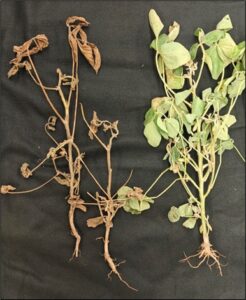
Figure 1 Sample from Clay County, IL. The dry, brown plants on the left were diagnosed with F. neocosmosporiellum while the green plant on the right was not. Both also tested positive for Phytophthora spp. root rot.
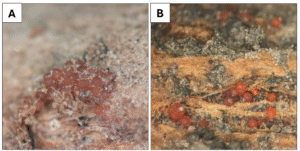
Figure 2 A) Perithecia of Fusarium neocosmosporiellum on soybean crown; B) Perithecia of Calonectria ilicicola (causal agent of red crown rot) on soybean crown. Both pictured under stereomicroscope magnification.
In August of 2026, the University of Illinois Plant Clinic received a soybean sample from Clay County, IL. The affected plants were dry and entirely brown, displaying stunting and dieback (Figure 1). After incubation in a humidity chamber, red perithecia fungal structures were observed on the lower stems and crowns under a stereomicroscope (Figure 2A). These appeared superficially similar to perithecia produced by Calonectria ilicicola, causal agent of red crown rot (Figure 2B), but microscopic examination revealed that the ascospores contained within were morphologically distinct (Figure 3). These ascospores matched the description of Fusarium neocosmosporiellum O’Donnell & Geiser (synonym: Neocosmospora vasinfecta E. F. Sm.). The fungus was isolated on acid potato dextrose agar, and DNA sequencing of the ITS and TEF-1 alpha regions confirmed the identity of the fungus as Fusarium neocosmosporiellum.
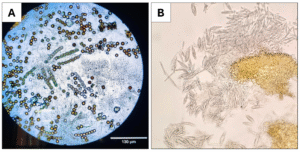
Figure 3 A) Asci and ascospores of F. neocosmosporiellum. The ascospores are globose, hyline to golden yellow, and ornamented. B) Squashed perithecium exuding ascospores of Calonectria ilicicola. The ascospores are spindle shaped, hyline, and slightly curved. Both pictured with a compound microscope.
F. neocosmosporiellum has been confirmed on soybeans in other states, most recently in Missouri in 2025 [1] and Mississippi in 2021 [2], and reported in North Carolina in 2024 [3]. Previously, it has been identified on soybeans in Arkansas (2015 [4]), Alabama (1980 [5]), and Georgia (1972 [6]). It has also been reported as a pathogen on peanut in Texas (2023 [7]), on alfalfa in China (2025 [8]), and on mango in Mexico (2021 [9]).
Symptoms observed on soybean plants from which F. neocosmosporiellum was recovered are similar those of other fungal diseases including red crown rot (caused by the fungus Calonectria ilicicola), and to a lesser extent sudden death syndrome (Fusarium virguliforme) and brown stem rot (Cadophora gregata). Symptoms of F. neocosmosporiellum infection include interveinal chlorosis and necrosis (yellowing and browning) of foliar tissue, wilting, and vascular discoloration. Under favorable conditions, both F. neocosmosporiellum and C. ilicicola produce small, red, round perithecia on the lower stems and crowns of the soybean plants.
Damage and yield loss in the field has not been established for F. neocosmosporiellum. Multiple species of Fusarium are known to cause root rot in soybean; the Crop Protection Network estimates yield losses of 3.99 million bushels across 29 US states in 2025 due to Fusarium wilt and root rot [10]. This emerging disease has been shown to infect plants in both the field and greenhouse; however, yield loss potential and management strategies remain under study. Identification is challenging due to misdiagnosis with other pathogens and limited knowledge of the symptoms caused by this fungus.
The first report for this pathogen published as a Plant Disease note is in progress for the state of Illinois.
To submit a sample to the University of Illinois Plant Clinic, please complete the diagnostic submission form available here. Soybean samples should consist of entire plants dug (not pulled) from the ground. Ideally multiple plants showing a variety or progression of symptoms are included.
For more information about Calonectria ilicicola, the pathogen that causes red crown rot in soybean, please see these articles from FarmDoc and the Crop Protection Network.
Author contacts: Diane Plewa (dplewa@illinois.edu), Esneider Mahecha Bojaca (esmabo@illinois.edu), and Boris X. Camiletti (bxc@illinois.edu).
Reviewed by: Talon Becker (tbecker2@illinois.edu).
All pictures are copyright University of Illinois Plant Clinic.
The University of Illinois Plant Clinic is an Extension program housed in the Department of Crop Sciences and a member of the National Plant Diagnostic Network.
References
- Haafke, A., et al., 2026. Plant Dis. 110:3566. https://doi.org/10.1094/PDIS-01-26-0235-PDN
- Jimenez Madrid, A. M., et al. 2023. Plant Dis. 107:955. https://doi.org/10.1094/PDIS-05-22-1200-PDN
- NC State Extension. https://rootcausereports.ces.ncsu.edu/library/72265e02-dabd-4bd5-9036-eabf03f9210a/. Accessed October 17, 2026.
- Greer, A. M., et al. 2015. Plant Dis. 99:554 https://doi.org/10.1094/PDIS-05-14-0559-PDN
- Gray, F. A., et al. 1980. Plant Dis. 64:321
- Phillips, D. V. 1972. Phytopathology 62:612
- Obasa, K. 2023. PhytoFrontiers. 3:268-271. https://doi.org/10.1094/PHYTOFR-06-22-0065-SC
- LeWang et al. 2025. Sci Data. 12:762. https://doi.org/10.1038/s41597-025-05073-x
- Molina-Cárdenas, L., et al. 2021. Canadian Journal of Plant Pathology. 43:714–721. https://doi.org/10.1080/07060661.2021.1880483
- Crop Protection Network. https://cropprotectionnetwork.org/publications/soybean-disease-loss-estimates-from-the-united-states-and-ontario-canada-2025 Accessed October 17, 2026.