Illinois Crop Update | August 21, 2026
Steve Brand – Commercial Ag Specialist
DeKalb County
Soil Conditions: Mildly Wet (soil is wetter than normal, local vegetation is healthy)
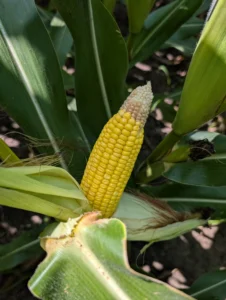
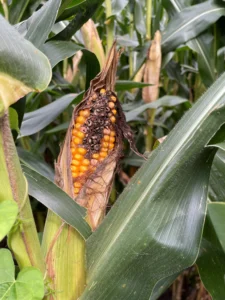
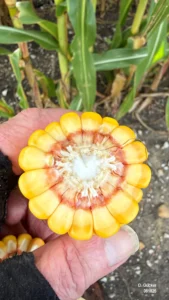
The heavy storms and even a derecho have passed, and we have been left with some gorgeous weather to end the week before some more rain chances next week. Not too many updates agronomically from my last update. Corn has moved into R5 dent across northern Illinois, with many fields at the early stages of senescence. I did find a good amount of tip back in corn in the fields I visited, and I attribute that to the heat dome we experienced coinciding with the end of pollination. The extreme heat and low winds we saw will kill pollen, and lead to lower movement of the pollen that did survive. There will be yield reductions in the fields I saw today, but the severity of the tip back you may see in your fields will align with planting date, and where your fields pollination lined up with the severe heat events we have seen this summer.
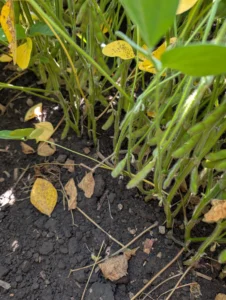
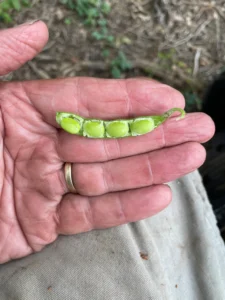
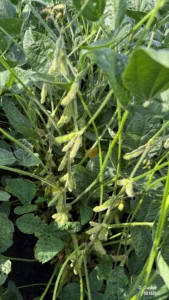
Soybeans are looking healthy with little disease. I did not see pockets of SDS as I was expecting, but that may still develop in the coming weeks. Soybeans are moving through pod fill in R5, and were very tall and robust in the fields I saw today.
Overall I’ve found very little disease in the DeKalb sector, with little to no tar spot, and very little disease in soybeans. Cooler temperatures next week may change that, but I feel like I’ve been saying that for weeks now. Tip back and lack of kernel fill is the major concern seen today.
Russ Higgins – Commercial Agriculture Educator
Grundy County
Soil Conditions: Mildly Wet (soil is wetter than normal, local vegetation is healthy)
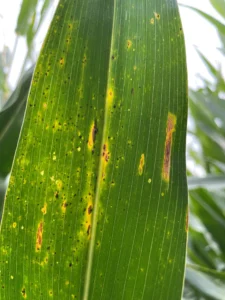
Additional rainfall this week has brought weeds through the soy canopy in some fields, especially in areas where the population was thinned by earlier flooding or saturation. The soy fields I have scouted continue to be mostly disease free. That statement does not hold up for the corn crop. I have been scouting a 108-day hybrid that was planted on April 24th, this corn has reached R5 or the dent stage. At this stage within the kernel, starch begins to harden at the top and works its way down to the kernel tip attached to the cob. There is variation between maturities and hybrids, but corn plants are generally in R5 for 30 days before reaching R6 or physiological maturity. At the beginning of R5 the kernel dry matter content is estimated at 45% of the potential final accumulation. Unlike the soy crop, and not surprising with August environmental conditions, foliar diseases have increased markedly in the recent week in corn fields. Southern rust, tar spot and gray leaf spot are all currently present in fields scouted that did not receive fungicide treatment. Another interesting anomaly noted on hybrids with shortened husk, is frequent damage to the exposed ear tip, presumably by birds or insects.
Doug Gucker – Local Food Systems and Small Farms Educator
Dewitt, Macon, and Piatt County
Soil Conditions: Moderately Wet (soil is damp, standing water may be present in low areas, water bodies are full)
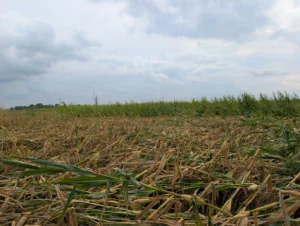
Generally, the corn and soybean fields look very good. The exceptions are fields that have been damaged by severe weather, or flooding.
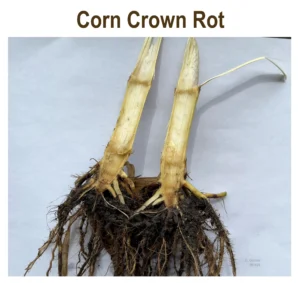
Over the past week, symptoms of Corn Crown Rot have become visible in areas of some fields. What I am seeing is these affected areas are patches of dead, lodging corn plants. Dr. Boris Camiletti, Extension Plant Pathologist, said the photo above appeared to be Corn Crown Rot. A sample is being sent to the U of I Plant Clinic for a diagnosis. Corn crown rot disease infects corn plants in the early portion of the growing season, and the disease is more prevalent in wet, compacted soils.
Talon Becker – Commercial Agriculture Specialist
Champaign County
Soil Conditions: Moderately Wet (soil is damp, standing water may be present in low areas, water bodies are full)
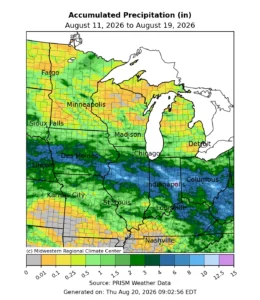
Wet conditions have returned to much of central IL. Following a bit of a dry spell in late July and early August, the Illinois Soil and Water Survey’s weather station in Champaign has registered more than 8 inches of rain over the past 9 days. The recent storms also brought high winds and a tornado in the southwestern portion of Champaign County, near Giblin, leaving pockets of crop damage (mostly corn) in that area. Standing water is also back in low areas of some fields. Many of these areas were already absent of crop due to the same issues earlier in the growing season, but standing water could also be seen in some areas where the crop had survived that early-season stress.
Wind damage appeared to decrease as I continued toward Sadorus and Tolono during my survey of southern Champaign County, although the flooding in low-lying areas persisted. Corn conditions were a bit variable. Many fields still look healthy and green, but some corn fields are starting to “fire”, or lose color in their lower canopy, indicating remobilization of nutrients from those tissues to the developing ear. Most fields range from the late dough (R4) to dent (R5) growth stages; I didn’t find any fields at black layer, or full maturity (R6), quite yet. Some fields are starting to show more symptoms of foliar disease, primarily gray leaf spot, but also some northern corn leaf blight. But with those fields generally at early dent (R5) or later, the level of disease observed is unlikely to have a large impact on yield.
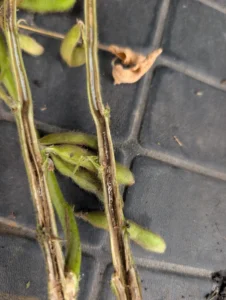
Soybean conditions are also starting to look more variable in the area. Again, many fields are looking healthy with a dense, green canopy and full pods, at or nearing the full seed (R6) growth stage. But some fields are starting to show areas with yellowing leaves, potentially indicating some kind of disease issue. In a couple of those fields, I collected plants and split stems to identify pith symptoms characteristic of brown stem rot. This may also be the issue in other fields I observed with similar foliar symptoms, but there are a number of diseases that often present similar foliar symptoms that may be difficult to differentiate and properly diagnose in the field. Resources are available from the Crop Protection Network to help with identifying these diseases (https://cropprotectionnetwork.org/publications/scouting-for-soybean-stem-diseases), and samples can always be submitted to The Plant Clinic (https://extension.illinois.edu/plant-clinic) to get a lab diagnosis. Having an accurate diagnosis is essential for selecting resistant varieties and developing a successful integrated pest management plan for future growing seasons.