Illinois Crop Update | July 17, 2026
Russ Higgins – Commercial Agriculture Specialist
Grundy County
Soil Conditions: Near Normal
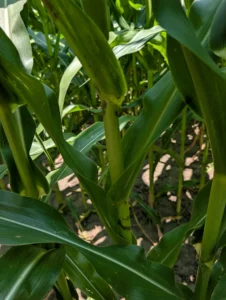
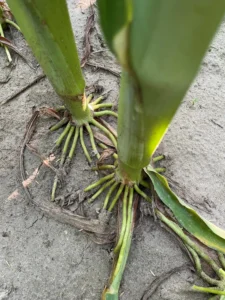
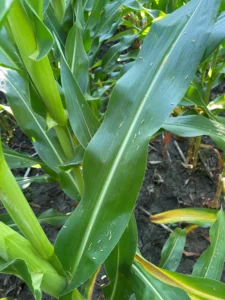
A favorable week for crop growth in the northeast region of Illinois. Corn is pollinating, despite predicted 90 degrees plus highs this week, most fields have adequate moisture and should not suffer despite elevated temperatures at this critical stage for the corn crop. I enjoy my early morning coffee looking across several corn and soy fields. This past week I noted most mornings start with a mist or fog. The mist does not come directly from the corn and soy crops, even though both put water vapor in the air through the process of transpiration. The morning mist is the result of the cooling of the moist air. As the air cools overnight, it reaches its “dew point” and can no longer hold water as a gas, causing water vapor in the air to turn into liquid droplets. Of significance to those scouting for crop diseases, the morning mist extends periods of leaf wetness, a favorable requirement to several fungal leaf diseases. This week, with the appearance of brace roots in the corn crop, the question of underground root expansion was raised. There are many limiting factors to root growth, too much or limited moisture, soil compaction or other natural barriers. However, the general suggestion is that root expansion in the corn crop continues through pollination. At this point the crop redirects energy toward grain fill. By this time with favorable soil structure, it is not uncommon for corn roots to extend to six feet in depth. Our soy plants tend to generate roots further into the vegetative stages, to R5 and R6, beginning and full seed.
The corn crop is R1 with kernel fertilization underway. Soy is between R2, full flower and R3, or beginning pod. Despite favorable conditions for leaf diseases, I have yet to see an outbreak of Tar Spot or corn or soy leaf disease in fields I have scouted. Growers are encouraged to remain diligent with both field visits and local reports.
Talon Becker – Commercial Agriculture Specialist
Douglas County
Soil Conditions: Near Normal
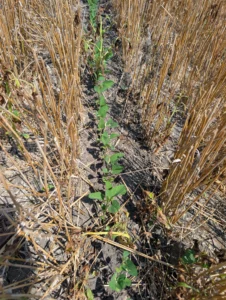
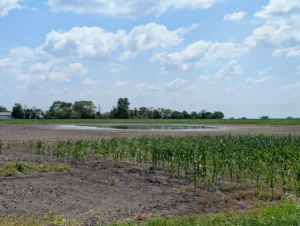
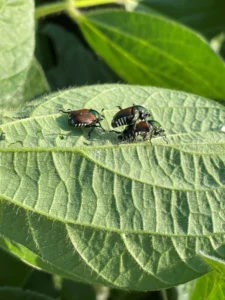
Most corn and soybeans in Douglas County have progressed into flowering stages. The primary exceptions to this are areas of fields where early season inundation led to crop stunting as well as a handful of fields where planting was delayed due to wet conditions, which now contain soybeans. These fields, as well as the few wheat/double-crop soybean fields I found, have soybeans ranging from late VC to early V4. Corn that has entered reproductive growth is still in the early stages, generally R1 (silking) to early R2 (blister). Developing pods can be found in the lower canopy of many soybean fields (R3). Foliar disease issues appear to be minimal in the county. Low spots in soybean fields still have a visibly lighter color as they try to recover from saturated soil conditions and possible soil-borne pathogen pressure. In corn, I found a couple fields with some Physoderma brown spot/stalk rot symptoms starting to show. This pathogen doesn’t generally cause economic losses, but it may be taken into consideration when prioritizing fields for harvest to minimize loss potential from lodging (https://cropprotectionnetwork.org/encyclopedia/physoderma-stalk-rot-of-corn).