


What to watch as soybean planting begins in 2026
You can also read the article in Portuguese and Spanish
March was wetter than normal across much of Illinois, with statewide precipitation averaging 4.85 inches, 1.91 inches above normal. The wet trend continued into the first two weeks of April, particularly in northern Illinois, which has received between 3 and 5 inches of rainfall since April 1. As a result, field activity has been somewhat limited, with NASS reporting 2.1 and 4.2 days suitable for fieldwork for the weeks ending April 5 and April 12, respectively.
March also ended up about 6°F warmer than normal statewide, and above-normal temperatures continued through the first half of April. Despite recent rainfall providing some drought relief, approximately 60% of Illinois remains classified as abnormally dry according to the latest U.S. Drought Monitor map (April 7). Looking ahead, the short-term forecast continues to favor warm conditions but also calls for frequent rainfall, so we expect planting progress to slow down in the coming days.
Have a plan for timely cover crop termination
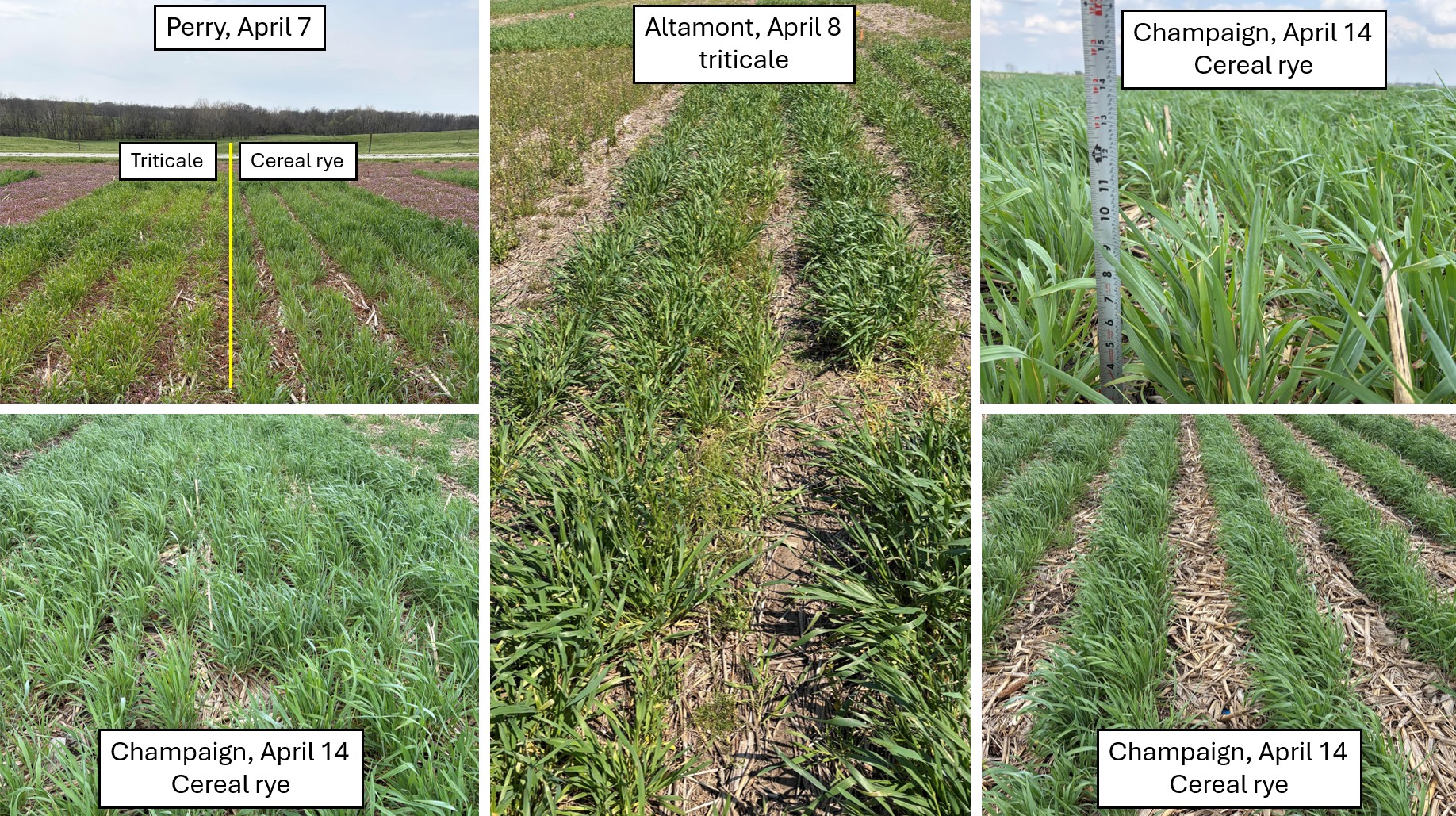
Above-normal temperatures in February promoted early greenup of wheat and cover crops, and cereal rye grown has been greater than in the past couple of years, especially in fields planted between late September and early October. Figure 1 shows cereal rye and triticale stands from different fields across the state. The cereal rye shown from Champaign was planted into corn stalks on October 24, 2024, at a seeding rate of 45 lb/acre, and most plants are currently about 8-10 inches tall. Cereal rye is a cool-season crop and will grow rapidly under the warm conditions forecast for this week. As a result, some consideration should be given to the timing of termination before the cover crop becomes excessively tall, particularly if wet conditions persist into next week, which could delay termination. Terminating the cereal rye at 6 to 12 inches tall generally provides enough biomass for erosion control, weed suppression, and keeping nutrients (especially N) in the field. Many growers can successfully plant soybean into terminated cereal rye taller than 12 inches, mainly if weed control is a primary purpose, but new cover crop users should terminate when the cereal rye is smaller and easier to manage.
Planting date window for Illinois
Soils were dry enough in some areas to allow fieldwork and planting to begin in late March. Corn planting has progressed at a near-normal pace, with NASS reporting 1% and 4% planted for the weeks ending April 5 and April 12, respectively; the five-year average (2021-2025) is 3% planted by April 12. Soybean planting started ahead of normal, reaching 7% by April 12, compared to the five-year average of 2%. If we use this data to answer the never-ending question, “Should we plant soybean or corn first?” the answer is a solid YES.
We have heard reports of more planting occurring this week, as many growers are trying to plant as much as possible ahead of incoming rainfall. In some locations, rain was forecast to begin Monday night, but amounts have been small so far. For example, Champaign received only 0.1 inches of rain on Tuesday morning, and several fields were planted later that afternoon. Warm and windy conditions have helped dry soils more rapidly, and if additional rainfall misses parts of the state this week, we would expect to see a continued increase in planted acres in the next NASS report.
Heavy rainfall following planting is the single greatest risk associated with early soybean planting. While warm temperatures accelerate the germination process, germinating seeds or seedlings in saturated soil die faster when the soil is warm because they run out of oxygen sooner. While temperatures are expected to drop early next week, they won’t stay low for long, and the threat of cold, wet soils does not appear to be very high.
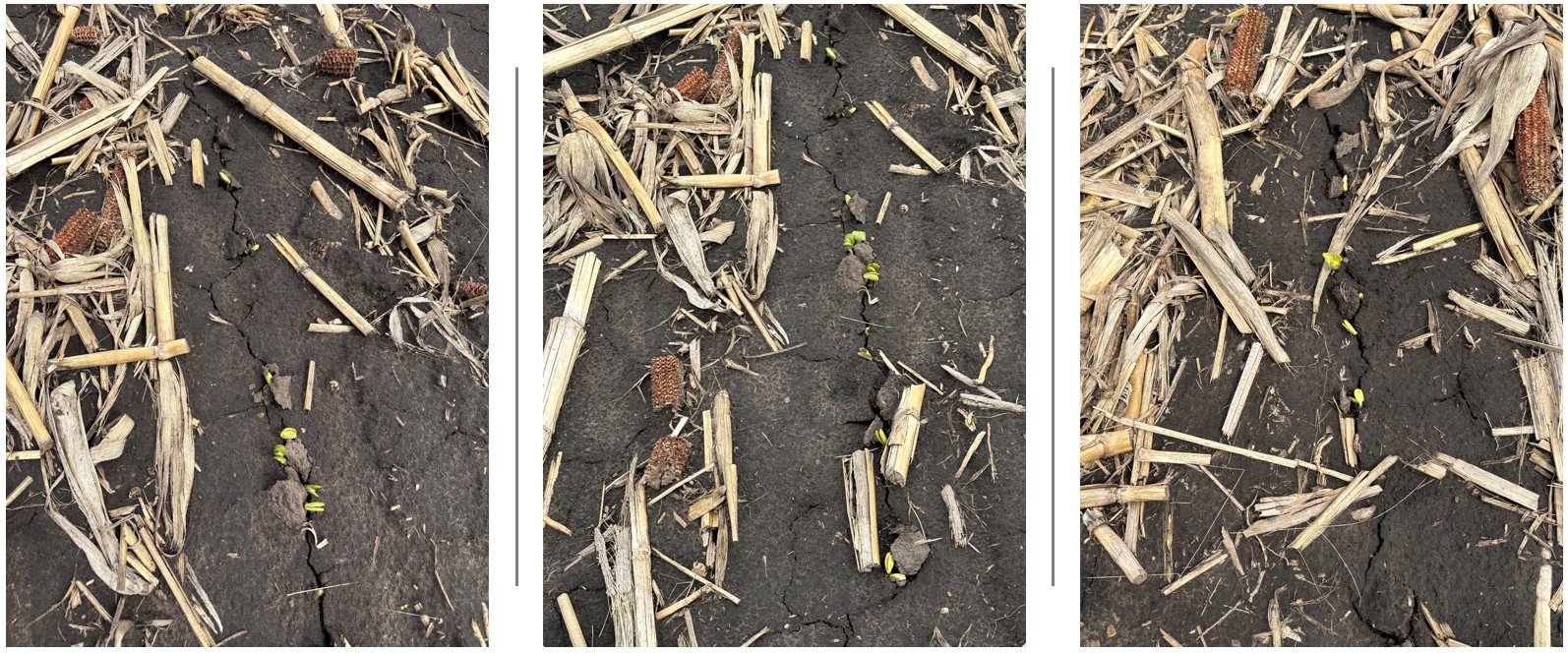
Soybean (or corn) that was planted on April 1 this year has accumulated around 195 and 135 growing degree days (GDDs) in southern and central Illinois by April 14, which should be enough to get the crop to emerge when planted at normal depths. In contrast, northern Illinois has accumulated around 75-80 GDDs since April 1. We generally estimate that about 110-120 GDD needs to accumulate after planting for crop emergence to occur, so early-April plantings in northern Illinois would not yet be emerged. We’ve seen in recent years, though, that early planting followed by low night temperatures may take more GDD. Taking 50ºF as the threshold temperature means that low temperatures of 30ºF and 50ºF register the same for GDD calculations, but low night temperatures mean that the soil stays cool longer, which in turn slows emergence. In a new project evaluating soybean replanting decisions, funded by the Multi-Regional Soybean Checkoff, we planted soybeans on March 25 at the UI Research Center near Monmouth (Warren County). About 161 GDD have accumulated since March 26, and the soybeans in this site have just began to emerge (Figure 2). Minimum air temperatures dropped to 33ºF two days after planting, followed by lows of 22ºF and 25ºF over the next two nights, before increasing to >40ºF thereafter.
University of Illinois research shows that planting soybeans anytime between April 10 and April 30 is likely to maximize yields. Yield losses begin to pick up as planting is delayed into May, declining to about 95% of the maximum yield by May 15, 88% May 31, 79% by June 15, and 76% by June 20. The maximum average yield was 70 bushels/acre, so each 1% change in yield is 0.7 bushels/acre. Of 38 trials conducted between 2010 and 2025, five had the first planting before April 10, but yields were no higher than those when planting was between April 10 and the end of April. While there may be exceptions, our data indicate that the “early planting” advantage was generally maximized if planting was done by the end of April.
Seeding rate
Soybean seed accounts for roughly 35% of direct production costs in Illinois, so it pays to spend some time refining seeding rates in years with low commodity prices, as growers look for ways to cut input costs. However, seeding rates should not be reduced below the amount needed to maximize profits, as yield losses associated with inadequate stands often outweigh any savings on seed. While responses to plant stand do vary across trials, our research shows that final stands of 105,000 to 115,000 plants (not seeds) per acre at harvest often produce the highest dollar return on the seed investment in most cases. Using 85% as the default for stand establishment is often reasonable. Good soil conditions and lack of heavy rain in the forecast should mean good emergence overall. When heavy rainfall is forecast shortly after planting, increasing seeding rates to offset anticipated stand loss is often less effective than delaying planting until the risk of excessive rainfall has passed.