Illinois Crop Update | June 5, 2026
Steve Brand – Commercial Agronomy Specialist
DeKalb County
Soil Conditions: Moderately Dry (soil is dry, plants may be browning or stressed, water bodies are low)
Another week, more beautiful and perfect weather for outdoor activities. More notably, another week of little to no rain as we continue to progress into an early summer drought. Most of northern Illinois would be considered to be in a D1 moderate drought as of now. The forecast is promising, with chances this weekend, and most of next week to remedy how dry it has been. With moisture in the forecast, disease monitoring, and keeping an eye on weed pressure should come back into focus. Between corn, soybeans, and wheat I have seen little to no disease to this point in the season which is a great start with how wet April was.
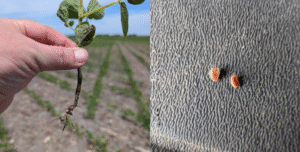
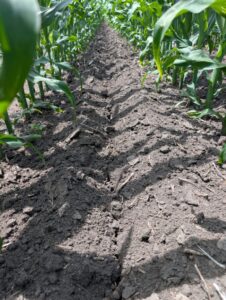
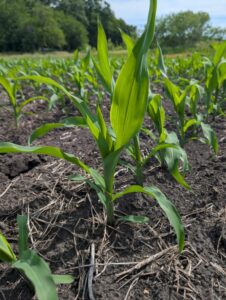
If I could describe the growing season in one word, it would be variable. Varying planting dates, emergence dates, growth stages within the same fields of corn and soybeans. We are seeing ranges of anywhere from struggling to emerge, to 3rd trifoliate in soybean or V3 in corn within many fields across the area. Hopefully the rain will even these patches across the fields over time, but some significant differences are being seen across corn and soybeans.
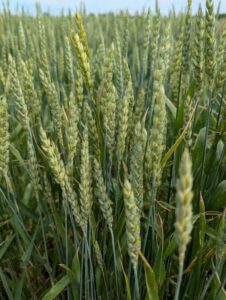
Wheat is in early Feekes 11 or ripening stage. Fields look healthy with little disease, and the weather has progressed the crop nicely as they begin to enter senescence.
That’s all for this week, and we shall see what sort of rain we get in the next week!
Russ Higgins – Commercial Agriculture Educator
Grundy County
Soil Conditions: Mildly Dry (soil is drier than normal, plant growth may have slowed)
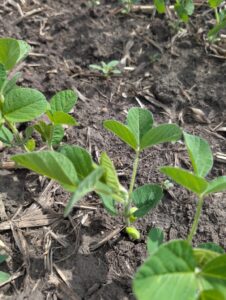
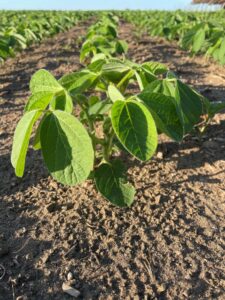
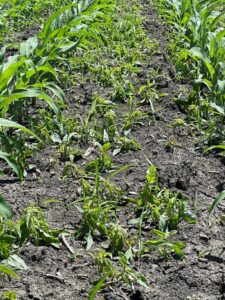
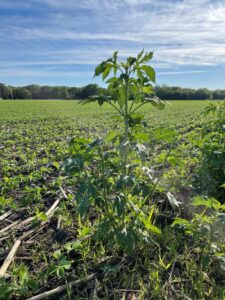
A dry week in the Northeast region, corn picked up one additional leaf (V6) and soy pushed out another trifoliate (now V2) in the fields that I am observing on a weekly basis. Hay harvest, nitrogen sidedressing, and post herbicide applications are all taking place. With the comparatively quick onset of dry conditions and stress on both crops and weeds, farmers are encouraged to evaluate post herbicide applications at least a week after application. Environmental stress, including drought, can slow active growth and herbicide solution absorption in plants, decreasing herbicide effectiveness on targeted weeds.
Reagan Tibbs – Commercial Agriculture Educator
Logan County
Soil Conditions: Mildly Dry (soil is drier than normal, plant growth may have slowed)
While crops across Logan County continue to look healthy, the lack of rainfall over the last week is starting to show some signs of stress, particularly in later-planted fields. The fields that were planted earlier in the season are in the V4-6 stage for corn and soybeans, with later-planted fields in the V2 stage. The first cutting of hay fields has also wrapped up across the county, with the hope of timely rains providing a good jumpstart for regrowth.
Doug Gucker – Local Food Systems and Small Farms Educator
Dewitt, Macon, and Piatt County
Soil Conditions: Moderately Dry (soil is dry, plants may be browning or stressed, water bodies are low)
Soybeans vary from V2 to V5 in general, with some fields showing the effects of early crusted soils and reduced emergence in those areas. Tall waterhemp has reached the 4-inch stage by the middle of the week. Corn varies from V2 to V7. all the crops have good color in spite of it being dry for the past 14 days. NOAA shows that the 3-county area is 2 to 3 inches below average rainfall over the past 2 weeks. Grass is browning in the lawns.
First cutting hay is being made. Sidedressing of corn is wrapping up, and post-emergent herbicide applications are in full swing.
Talon Becker – Commercial Agronomy Specialist
Douglas County
Soil Conditions: Near Normal
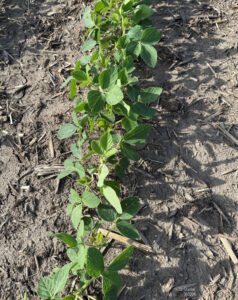
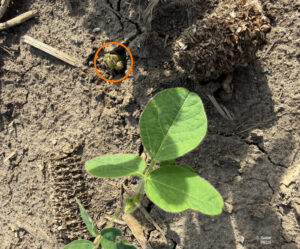
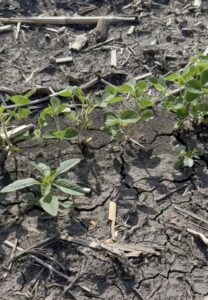
During my survey of Douglas County on Wednesday afternoon, I saw just a handful of fields yet to be planted, with planters rolling in a couple of them. Others were busy filling in some low spots of fields that failed to survive the wet conditions we experienced in the region in late April and early May. Timely post-emergence herbicide applications were also being made, with most waterhemp seedlings in the area still small enough to effectively control. While most fields were planted, somewhere around 10% of fields did not yet have emerged crop. Soybean fields were generally in the V1-V2 range, with active nodules starting to form. Several fields were showing some damage on early leaves, likely related to the cool, moist conditions experienced during emergence and possibly compounded by increased duration of contact between those tissues and soil-applied pre-emergence or carryover herbicides. However, new growth looked healthy in most fields. Most corn was in the V3-V4 range, with some early-planted fields getting up to V8. Signs of side-dress nitrogen could be seen in several of those early-planted fields, with most of the more mature corn fields showing a nice dark green canopy. However, some of the corn fields in the V3-V5 range were showing uneven canopy color, possibly still waiting on some side-dress nitrogen.