Late-season weather and the 2026 Illinois corn crop
You can also read the article in Portuguese and Spanish
Weather and crop condition
Planting and emergence of the 2026 Illinois corn crop began a little earlier than normal, and overall average temperatures this summer have kept crop development near a normal pace (Figure 1). Rainfall and temperature fluctuations in late April and early May resulted in uneven emergence and stands in some fields, while repeated rainfall events during June caused flooding and prolonged periods of saturated soils across much of the state.
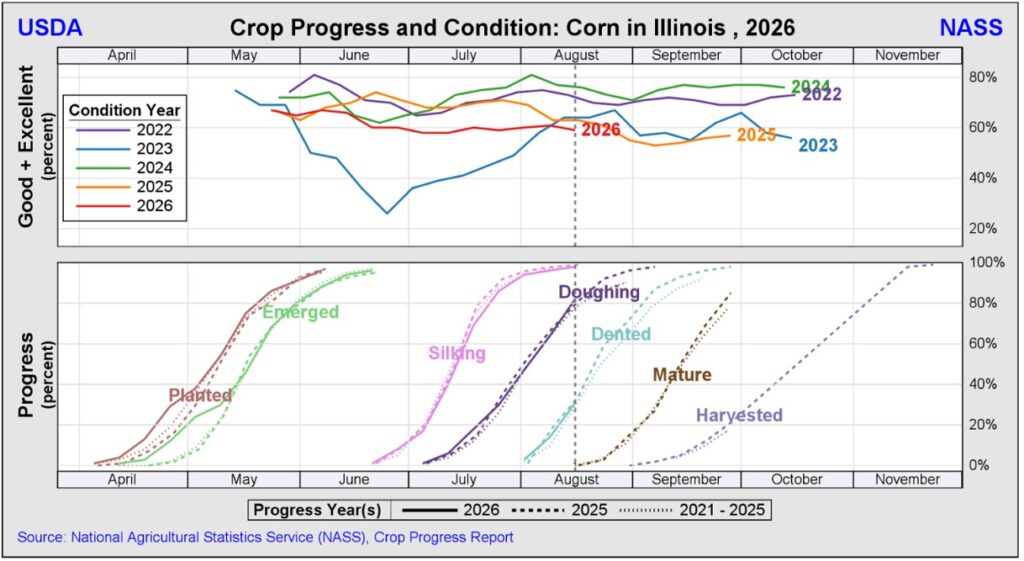
The effects of June flooding were reflected in the USDA-NASS crop condition ratings, which declined during June and have remained mediocre – around 60% good + excellent – since then (Figure 1). Ratings in 2025 were higher through much of June and July before declining in August as drought intensified. Data from the website Crop-CASMA show that statewide NDVI values during the first week of August were similar to those at the same time in 2025; despite very different weather patterns, crop canopies were very good in both years.
The big story of the 2026 growing season has the abundance of rainfall across much of the state, especially in May and June and recently in mid-August. July was relatively dry in parts of the state, which we think helped the roots get established after early wetness. Parts of northern and central Illinois got up to 12 inches of rain during the second week of August, which is a lot more than needed; only about 6% of the state is abnormally dry according to the August 18 Drought Monitor map. With few exceptions, soil moisture will be more than adequate to get the crop to maturity without stress.
Pollination and kernel set
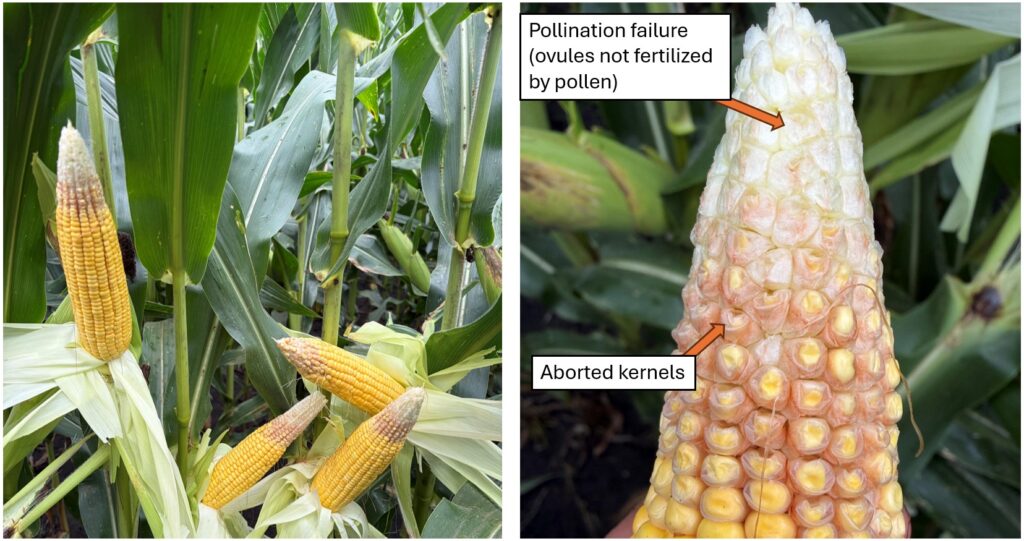
Early-planted corn began silking by June 21, and the 50% silking date was July 14, only about two days later than the 5-year average of 2021-2025 (Figure 1). The first half of July was 2 to 4ºF warmer than normal, maximum temperatures in the low to upper 90s in places. This, coupled with drying soils, resulted in some ear tip-back, where kernels at the tip of the ear either failed to fertilize or were aborted shortly after fertilization. Rain in July may have helped kernel set in some of the fields planted a little later.
Figure 2 shows an example of tip-back from corn plots that silked around July 20 at the University of Illinois research farm in Urbana. Pictures were taken on August 11, and the corn was at the R4 stage. In this case, reduced kernel set resulted from the combination of pollination failure and kernel abortion. While tip-back can reduce yield potential, its effects can be partially offset if fields still have good ear counts and the canopy remains intact with good color through grain fill. For instance, at 34,000 ears per acre and 80,000 kernels per bushel, it takes 500 kernels per ear (or 17 million kernels per acre) to produce 212 bushels per acre. If kernels end up larger than normal and 75,000 kernels make a bushel, the same field would produce 226 bushels per acre; at 70,000 kernels per bushel, yield would be 242 bushels per acre. Nevertheless, consistently high yields are more often associated with high kernel numbers than with unusually large kernels, and exceptional yields may often come when there are 20 million or more kernels per acre.
USDA yield prospects
The USDA-NASS August 1 estimate (released on August 12) pegged Illinois corn yield at 212 bushels per acre, down 2 bushels from final yield in 2025. The 2026 trendline yield based on the yields trend since 1990 matched the 2026 estimate of 212. Estimating yields in August is somewhat difficult because, while we may have an accurate estimate of kernel number, kernel weight remains uncertain before maturity.
We’ve seen examples of August estimates both overestimating and underestimating final yields. Yield in Illinois exceeded the August estimate by 11 bushels per acre in 2022, increasing from 205 (due to severe dryness lasting into July) to 214: kernels were heavier than usual in many fields, with some fields nearing 60,000 kernels per bushel (Nafziger, 2022). In contrast, yield in 2025 ended up 7 bushels per acre below the August estimate. Kernel numbers were average that year, but the very dry August-September period limited grain-fill rates and resulted in lighter kernels than normal. Leaf diseases contributed to this in parts of northern and western Illinois, where southern rust came in unexpectedly and tar spot developed later in the season.
Whether the 2026 estimate holds true will depend largely on how the crop finishes during the remainder of the grain-filling period and on the how much effect drowned-out areas might have on field-average yields. Plants in the flooded and waterlogged portions of fields have shown limited recovery in most fields and will reduce field-average yields, although the magnitude of that reduction is difficult to quantify before harvest. In fields where low areas are again flooded in August, grainfill before the deluge may result in some production in these areas.
Finishing the season
Statewide temperatures averaged 1 to 5 degrees above normal in July, with very high growing degree day (GDD) accumulations due mostly to warm nights. As of August 16, NASS reported Illinois corn slightly ahead of schedule, at 82% dough, 31% dented, and 1% mature. The Corn Growing Degree Day (GDD) tool shows that a 112-day RM hybrid (estimated to need ~2,700 GDD from planting to maturity) planted in Champaign County on April 20 or May 10 is projected to reach maturity on August 31 and September 9, respectively.
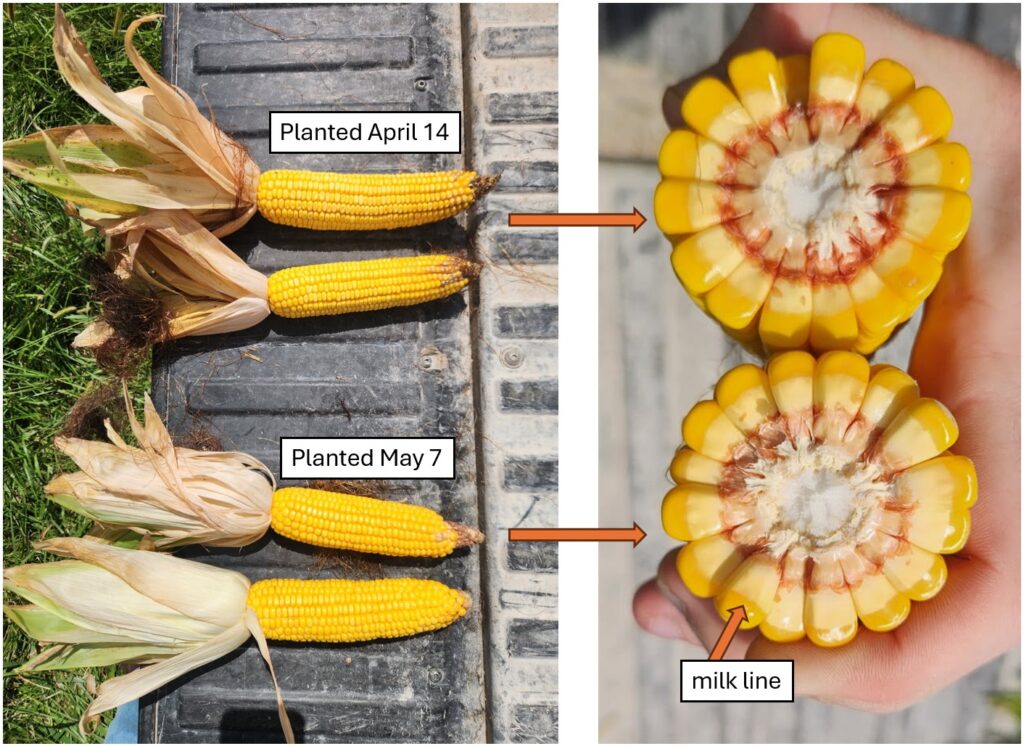
Figure 3 shows differences in maturity from a planting date study at the Orr Agricultural Research Center in Pike County, using an 115-day RM hybrid. About 250 GDD were accumulated between April 14 and May 7 planting dates, and both crops were at the dent stage as of August 17. Corn planted on April 14 had kernels with the milk line a little more than halfway down, with >90% of kernel dry matter accumulated. The milk line in the corn planted on May 7 was about ¼ down, with about 65% of kernel dry matter accumulated. With warm weather in the forecast, the April-planted crop should reach black layer within about 8-9 days, while the May-planted crop should reach maturity in about three weeks. Ears in both crops have 16 rows of kernels with 32-35 kernels per row, and with very little tip-back, we should expect good yields.