Illinois Crop Update | July 10, 2026
Kathryn Seebruck – Commercial Agriculture Educator
Winnebago County
Soil Conditions: Mildly Wet (soil is wetter than normal, local vegetation is healthy)
With the ample rainfall received over the past month, some fields in the area with low spots still have standing water and areas where the crop will not recover. It is advised to be diligent about scouting as fungicide application decisions are being made. As has been shared in other reports, the Crop Protection Network has useful resources that can aid in that decision making process. These include disease maps, the crop risk tool, and a fungicide ROI calculator: https://cropprotectionnetwork.org/
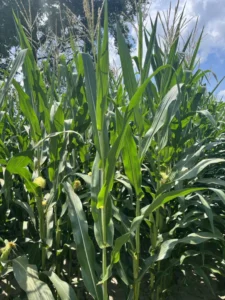
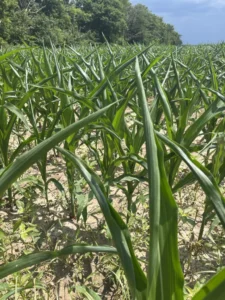
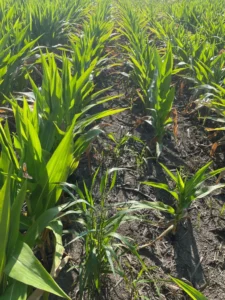
The corn in this field is exhibiting some potassium flashing on older leaves, which is a common occurrence in this field and tends not to have a negative effect on yield for this particular field. Little to no disease presence was noted, as only one northern corn leaf blight lesion was found.
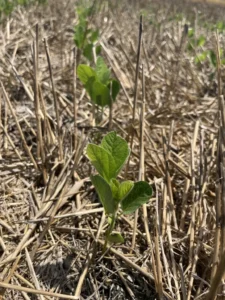
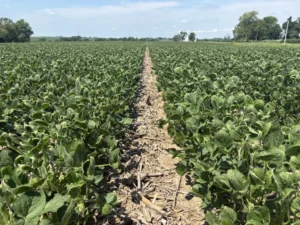
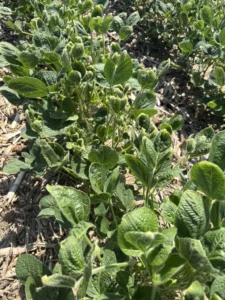
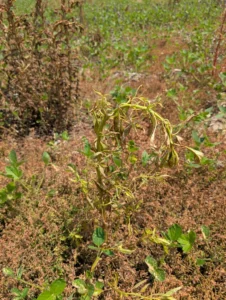
The soybeans in this field (R2 growth stage) are exhibiting cupping on the upper canopy, and the cupping is widespread across the entire field. These are Enlist soybeans that were sprayed with Enlist + Liberty ten days prior to this field visit. There are other soybean fields within a roughly three-mile radius that are also exhibiting widespread cupping, along with fields that are not exhibiting any cupping. This could potentially be due to off-target dicamba movement.
Russ Higgins – Commercial Agriculture Educator
Grundy County
Soil Conditions: Near Normal
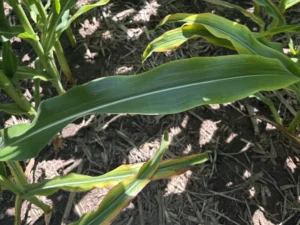
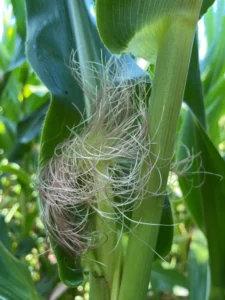
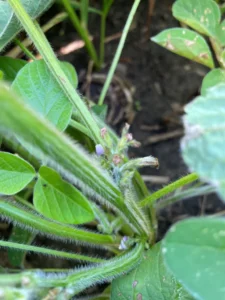
This week farmland in the northeast region received additional precipitation and winds over the July 4th weekend. Rainfall totals reported ranged from 1+ inches to isolated fields that received 9+ inches. When sharing an update, the challenge is whether to report on the part of the field that has been unaffected (or even enhanced) by the rainfall, or the parts of the field that have been killed or damaged by ponding or saturated soils. Depending upon where you look, there are outstanding portions of fields, but if you evaluate the field as a whole and note the unevenness and drowned out areas the field, overall rating diminishes. Soybean are at R2 or full flower, at this stage the plants begin a period of rapid dry matter and nutrient accumulation. This week shorter season or earlier planted corn hybrids have reached R1 or pollination and scouting for foliar leaf diseases has intensified. This job will soon be less pleasant when pollen shed increases. In corn fields scouted, I have yet to find symptoms of tar spot. I have noted black specks on corn leaves, but the tar spot stromata (lesions) cannot be brushed off. What I have found are either wind deposited dirt or possibly insect frass or excrement. If you can wipe off the black spot on a leaf it is not tar spot. Follow our weekly reports for updates on gray leaf spot, tar spot, southern rust and other diseases found in both corn and soy across the state.
Reagen Tibbs – Commercial Agriculture Educator
Logan County
Soil Conditions: Near Normal
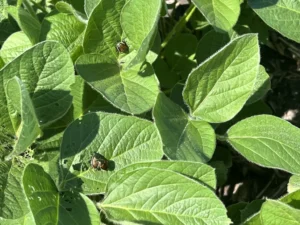
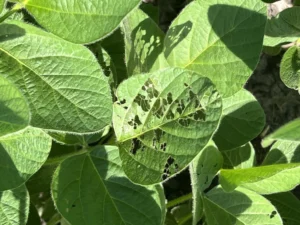
The warm temperatures across the County over the last few days appear not to have slowed down crop progress at all. At the Hartsburg Research Plot in northern Logan County, soybean growth is mixed throughout the field. In the parts where there was standing water, plants are in the V5 stage, while the rest of the field is at V10. In the parts of the field that had standing water, there are many empty spaces where plants have not developed or failed to emerge. Volunteer corn is the most-present weed at the Hartsburg Research Plot this year, given the late planting date. Other weeds such as Palmer amaranth, Redroot pigweed, and Common waterhemp are also starting to show themselves. While there are Japanese beetles in the field too, they do not appear to be causing significant damage to the leaves, with only a small handful of plants and leaves showing major signs of damage.
Talon Becker – Commercial Agriculture Specialist
Champaign County
Soil Conditions: Near Normal
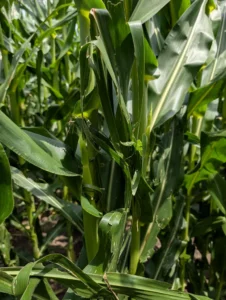
After a very warm week last week, temperatures have been much closer to normal following the storm system that moved through the area on July 4th. The heat did help dry out many of the fields that had been waterlogged for several weeks. As I drove through southern Champaign County on Tuesday (7/7) afternoon, only a couple fields I passed had water standing or visibly saturated soils. Some of the drowned-out areas of soybean fields have been replanted, with seedlings just starting to break through the surface. The few wheat fields I saw during my survey had been harvested. Double-crop soybean planting and late post sprays on acres that were likely too wet a couple weeks ago are ongoing. Most soybean fields I visited were somewhere in the flowering to beginning pod stages (R1-R3), with the exception of those that were stunted or delayed by the wet start to the season. Early planted corn fields are starting to flower in near ideal growing conditions, with adequate soil moisture and more moderate temperatures. With these conditions, the remaining corn in the area still in vegetative growth will progress rapidly and likely reach flowering in the next week or so. I did not find any fields with major foliar disease issues, despite the wet start to the season. However, I did find a couple soybean fields with Japanese beetles actively feeding, but damage was still isolated and appeared to be below the recommended 20% defoliation threshold for control in flowering soybeans.
Dane Hunter – Commercial Agricultural Specialist
Marion County
Soil Conditions: Mildly Wet (soil is wetter than normal, local vegetation is healthy)
From late April to late June we were about the wettest area of the state according to Trent Ford. Crops that got in the early window in April look great. Later planted crops had much more difficulty emerging between heavy rains. Lots of delays and replant decisions have been made through this region between I-70 and Rte 50. The precipitation also stymied the harvest of what was otherwise a relatively early maturing crop. Heavy winds and hard rains battered kernels from heads even if the wheat avoided lodging. Subsequently, planting of doublecrop and even some first crop soybeans stretched into the first week of July. I saw a drill still running on July 7th, planting first crop beans, not replants. Folks had to decide whether to mud in double crop soybeans or wait for rutted fields to dry. Thankfully the moisture persisted long enough that those mudded in plantings didn’t turn to concrete before emergence. I’ve seen more tilled double crop fields this year than I can ever remember, a testament to the wet conditions during harvest.
The good news is our subsoil moisture is fully recharged after a dry winter. Corn that got planted in our early window is at VT or even on the verge of R2. Despite the recent hot temperatures, it has established a good root system and does not seem to be showing signs of heat stress. Late planted corn (Late May to June) didn’t have as much time to establish a strong roots and shows some signs of heat stress, sometimes just in patches of thin soil and some entire fields.