


Early-season crop progress and conditions – June 2026
You can also read the article in Portuguese and Spanish
Despite some wet and cold periods in April and May across parts of Illinois, the 2026 corn and soybean crops were planted at a near-normal pace. Soybean planting began early and remained ahead of corn planting throughout the season, with 7% of the soybean crop planted by April 7 (5% above the five-year average for 2021-2025) and 50% planted by May 5. The first NASS report for corn indicated 1% planted by April 5 and 50% planted by May 10.
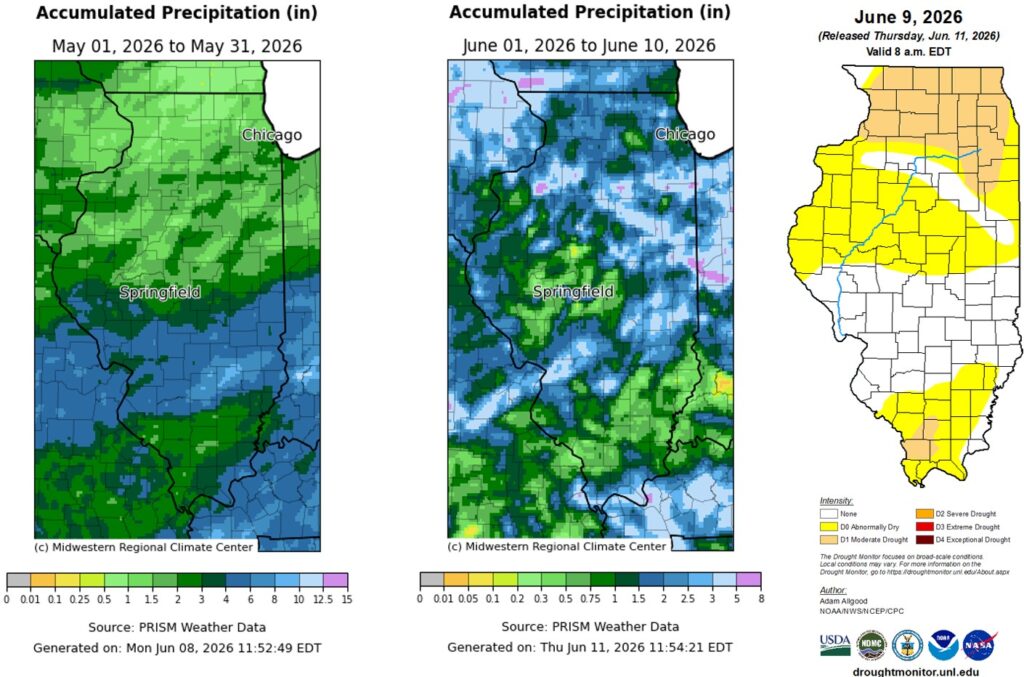
Average temperatures during the first half of May ranged from 3 to 8°F below normal, while in the second half of the month, temperatures were 1 and 4°F above normal; this pattern continued into June, with temperatures ranging from 1 to 8°F above normal. Much of the rain over the past month has come from thunderstorms rather than widespread frontal systems, resulting in highly uneven distribution across the state. Aside from an area of normal to 50% above-normal rainfall in central Illinois, May rainfall ranged from less than 25% of normal in parts of northern Illinois to 75% of normal in parts of southern Illinois (Figure 1). Several systems that moved through central and northern Illinois on June 7–10 brought 0.7 to more than 5 inches of rain in some places, which should help alleviate emerging drought concerns as crop water demand increases in June. The most recent U.S. Drought Monitor map (June 9) indicated that approximately 42% of the state was classified as D0 (abnormally dry), with an additional 20% in D1 (moderate drought). We should expect a decrease in drought-affected areas in the next update (June 18).
Looking ahead, forecasted rainfall totals for next week between 1 and 2 inches for northern Illinois and up to 3 inches in southern Illinois. Longer-range outlooks for mid-June suggest that warmer and wetter conditions are likely to persist, which could further replenish soil moisture and promote good crop growth and development moving forward.
Corn
Corn crop condition ratings as of June 7 were 67% good + excellent (G+E), which is more or less normal at this point in the season. This likely reflects, in part, variability in crop establishment in areas that received heavy rainfall shortly after planting. For comparison, current ratings are slightly below the 69% G+E reported at the same time last year and lower than the 74–77% reported in 2022 and 2024. It may be worth noting that although ratings were high early in those years, they declined into the mid-60s by late June as drought conditions developed. One of the highest early-season ratings in recent years occurred in 2018, when 83% of the corn was rated G+E following a very warm and relatively dry May. In contrast, above-normal rainfall can negatively impact crop establishment by causing poor stands, drowning of plants in low spots, increased seedling disease pressure, restricted root growth due to low soil oxygen, and movement of mobile nutrients (primarily nitrogen) below the rooting zone, along with N losses from denitrification in saturated soils. The symptoms of afternoon stress from dryness might lower ratings, but in June, we’d much rather see such stress than have inches of rainfall and water standing in fields.
Stands are good in most fields, and the warmer temperatures in recent weeks have increased growth rates and improved uniformity in plant size. From April 1 through June 10, the accumulation of growing degree days (GDD) was about 845 (155 above normal) in northern Illinois, 1005 (155 above normal) in central Illinois, and 1,150 (180 above normal) in southern Illinois. Totals since May 1 are closer to normal, at about 605 (85 above normal) in northern, 670 (50 above normal) in central, and 725 (25 above normal) in southern Illinois.
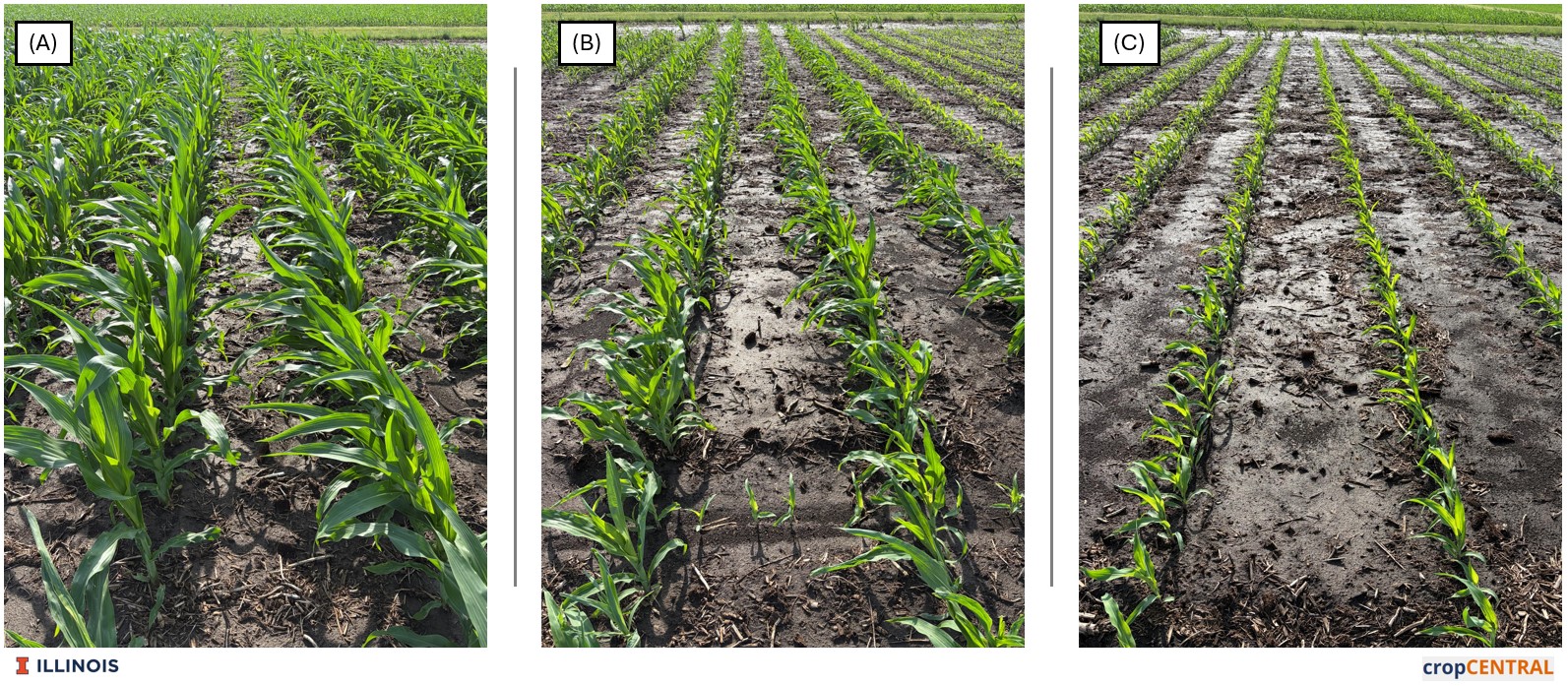
At a planting date trial in Urbana (Figure 2), corn planted on April 12 reached the V9 stage by June 8, having accumulated 887 GDD. Corn planted on May 4 was at V6, with 617 GDD, while corn planted on May 21 was at V4 with 404 GDD accumulated. Corn planted on June 5 had not yet emerged, with 105 GDD accumulated. With daily accumulations of about 23-25 GDD, the corn crop planted in mid-April should be showing tassels and silks by the end of June and the first days of July. Warmer conditions in the forecast are expected to further accelerate crop growth. As plants approach V10-V12 stages, canopy development increases rapidly, and sunlight interception is expected to reach about 90% by around V12 (approximately chest-high). This is another critical stage for corn, as growth rates are high and so is the demand for water and nutrients. From a management perspective, a key goal is to achieve a uniform stand with a good canopy by late June, which helps maximize potential kernel numbers and sets the crop up in good condition to fill those kernels later in the season.
Soybean
Early-season condition ratings for the soybean crop have been about average as well, with 64% of the crop rated G+E. Soybean stands are also generally good in most fields; however, crops planted from late April through early May have shown slower-than-usual growth. This is largely due to cool soil temperatures combined with wet periods, which restricted root growth and delayed root expansion into the bulk soil. This is evident in our planting date trial in Urbana. Soybean planted on April 12 had reached the V6 stage (sixth trifoliolate) by June 8, while soybeans planted on May 4 were at V2 (second trifoliolate) and approximately 5–6 inches tall after five weeks of growth (Figure 3). In contrast, soybeans planted on May 21 were at the V1 stage (first trifoliolate).
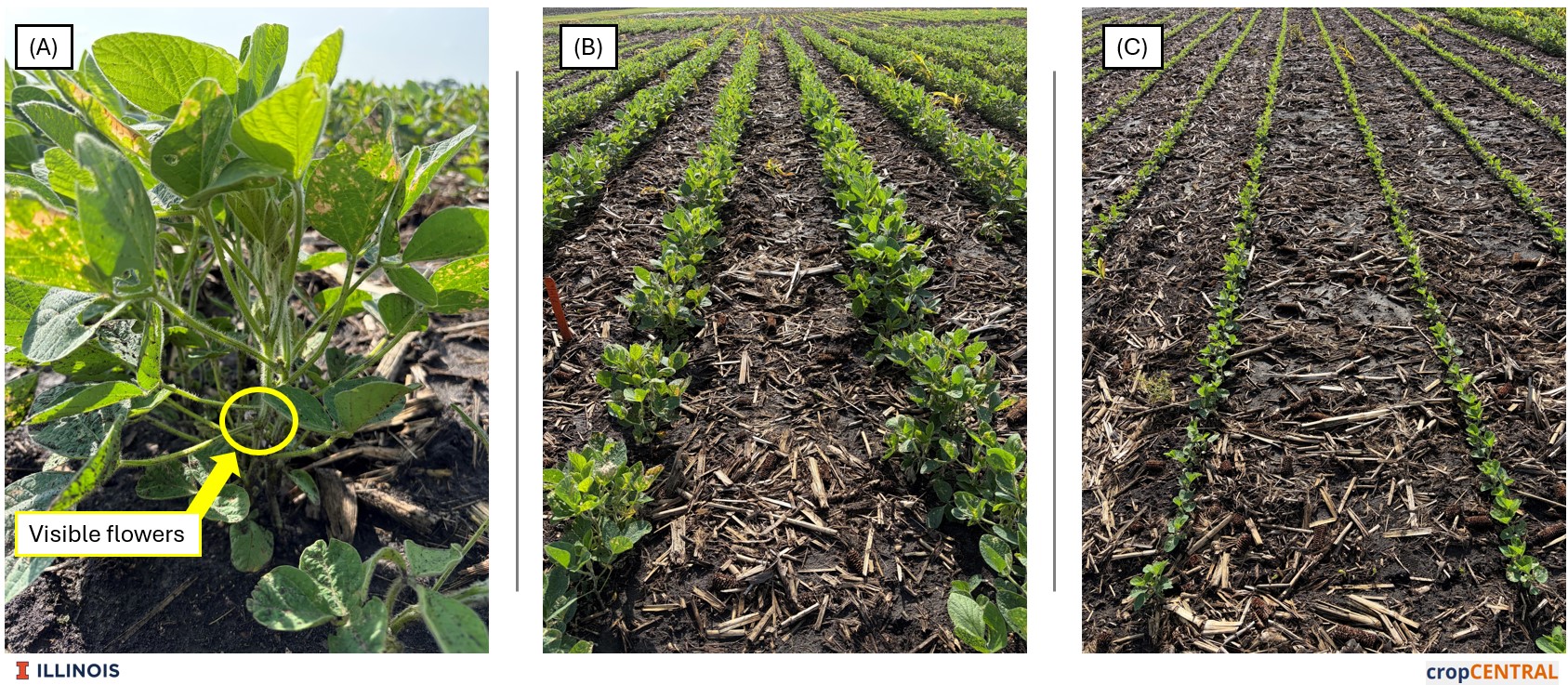
The trial includes three maturity groups at each planting date; an early (MG 2.4), medium (MG 3.4), and late (MG 4.0) variety adapted for central Illinois. Across all three maturities on the earliest planting date, flowers were visible on about one-third of the plants on June 8. Flowering in soybean is primarily driven by photoperiod, but warm temperatures will also speed it up, and plants need to reach the V3 stage before they’re capable of flowering. Once it starts, flowering progresses both upward and downward along the plant. As we approach the summer solstice (June 21), and if it stays warm (with daily highs above 80ºF), it wouldn’t be surprising to see at least some flowering in soybeans planted in mid-May. Conversely, flowering could be delayed if temperatures cool, which remains a less likely scenario based on current forecasts.
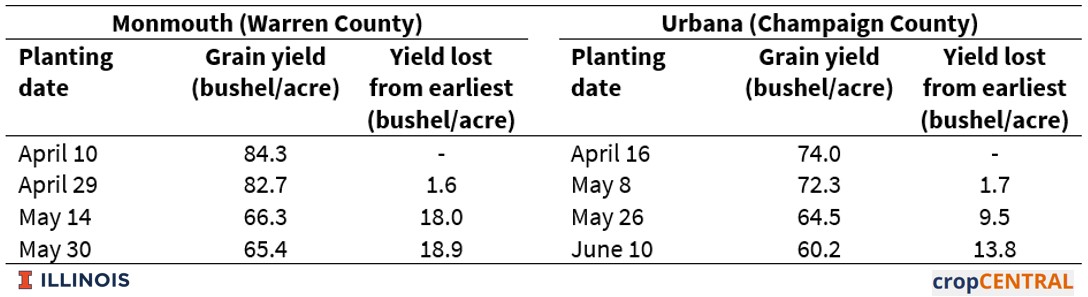
It is not yet clear how the slower early growth may influence yield potential for soybean planted in early May. Impact will likely be minimal if warm and wet conditions persist, allowing growth rates to accelerate and plants to continue adding nodes. Flowering typically marks the beginning of a period of rapid growth and nutrient accumulation. Most of the biomass accumulation at this stage is still allocated to vegetative growth, as plants continue to add nodes and leaf area until the beginning of seed fill, typically 4-6 weeks later, depending on growing conditions. Ultimately, as long as canopy development is rapid and the canopy closes about the time seed fill begins, with adequate pod set, the crop should be well positioned to achieve high yield potential if conditions remain favorable during pod filling. Last year, for instance, June was warmer and drier than normal, and dry soils slowed crop growth some, but ample rainfall in July supported rapid growth. Data from trials conducted at the UI Research Centers in Monmouth and Urbana showed that soybean planted the first week of May yielded within 2 bushels of those planted by mid-April (Table 1).
Final thoughts
If no major problems (such as widespread flooding) occur, we expect that crop condition ratings will improve in Illinois in the coming weeks. Previous seasons remind us how dynamic (and, well, useless in predicting final yields) these ratings are. In 2023, for example, ratings for both crops plummeted in Illinois as drought intensified in June, then they rebounded to near-normal levels (although more for soybeans than corn) by August, and yields were good for both crops. While we don’t want soils to dry out too much in June, not having standing water over the next few weeks will help maximize crop potential. Reaching that potential, as always, will require that rain adds enough water to the soil to keep the crop supplied through the rest of the season.